Monday, August 27, 2018

Winona's Hemp Thread Mill

Indiegogo Campaign
Source: indiegogo.com


It’s time for the next economy.  That economy is going to be kind and restore our Mother Earth.   We are going to build the next economy and we are asking you to support us as we light the eighth fire and build a local hemp economy. Please join us and invest in Winona’s Hemp.

Aaniin Niijii (Greetings Friends),

 
For most of my life, I have been fighting bad ideas.  From power lines to pipelines, I have engaged in processes set up to permit pollution and not protect the public.   The time has come to stop being reactive and become proactive. I have made a commitment to grow the future, to grow hope.  Omaa Akiing --on the land to which the people belong-- we are doing that.  I am so thankful for your support and hope you will join us as we move ahead.

Let me tell you our story.

Last summer, I put a call out for support to help bring my vision of a new economy for my reservation to life.  The response was overwhelming, and we far exceeded our fundraising goals. The interest we garnered has inspired us to keep going and keep sharing.  
This spring, I have been blessed to be supported in my goals by a number of folks helping to make my field of dreams a reality.  We have put our hearts, minds, and bodies to the beauty of bringing life -- seeds and hope. We began cultivating our farm with prayers, tobacco, our hands, horses, and a small tractor.  This is just the beginning.
With the power of love and commitment, people have come together to plant our heritage varieties of corn, beans, potatoes, squash, Jerusalem artichokes, and tobacco - asema - as it is called in Anishinaabemowin.  Winona’s Hemp and Heritage Farm is coming alive. Our barn and store are painted and ready, our fields are full of fiber and vegetables, and we are ready to move to the next step- processing our hemp.
Winona’s Hemp and Heritage Farm also helps to support the Anishinaabe Agricultural Institute (AAI).  This project is inspired by my father, who ran an agricultural research station for years. At AAI we are working on many projects, including horse-powered agriculture.  Our region has a deep and long relationship with the Horse Nation, which we are working to re-invigorate with our relatives to the west- the Dakotas. For the last four years, we have been riding with the Dakotas to oppose bad ideas proposed by the Enbridge corporation; but now we are riding with the Dakotas to spread horse medicine.  Horses are sacred beings and the Dakotas are teaching us their horse songs and how to use the horse medicine. Our hope is to use our herd for healing our communities and our land. We are grateful for these relationships and remembering our long-time relatives.
     
After growing hemp for the last three years, this year's harvest promises to be the most bountiful.  I've spent the last year networking with other hemp growers and have learned a lot. I’ve expanded the varieties I am growing and now have several small pilot plots of CBD and fiber varieties.  My main interest is in fiber and fabric, but I know this plant to be a medicine and want to provide this medicine to my community that desperately needs healing.  Securing seeds for fabric varieties has been especially difficult.  We are not sure if this is a result of the Trump Administration, but we have persevered. In a gift from Gitchi Manidoo,  I was granted access to the White Earth tribal field.  
 
This field is where my Tribe, the White Earth Nation, planted several hemp varieties last year.  They had great success in growing, and this year, the field re-seeded itself. These “volunteer” plants are now in their second year of adaptation our northern Minnesota climate.   Some of that hemp is eight feet tall. We are now harvesting the stalks for fiber and letting some go to seed. We intend to expand these cultivars and anticipate growing wild varieties from Nebraska and Minnesota to strengthen our seed stock. Our goal is to develop quality hemp fiber varieties adapted to our climate.   

This is the field of dreams and the growing of hope for our region.

Hemp has a long history on this land, and Minnesota once hosted eleven hemp mills.  Those mills are no longer here, but they are remembered by elders in northern Minnesota; elders whose families made rope, or clothing.  These memories are memories of a locally grown economy.  We remember this story and are working to bring it back.  We also recognize the Indigenous leaders who have urged a return to hemp- John Trudell and Alex White Plume.  Indeed, Indigenous people have a long history with hemp. The name “Tuscarora” refers to People of the Hemp shirts, I am told.  
A generous donation from Project Earth has allowed us to purchase a small industrial decorticator --the machine needed to separate the fiber from the rest of the hemp stalk.  We will move this decorticator from farm to farm as we build a local economy, an artisan economy. Once the hemp is decorticated, we need to spin that fiber into thread-- so my new ask is to help me develop my thread mill.  I have found a perfect building for my needs- a small industrial building in Callaway, Minnesota. Callaway is on the western edge of the White Earth Reservation, near the Tribal Hemp field and a major North-South railroad line.  Callaway is also a perfect place for wind and solar power.

This is my next hope- to purchase the building within which we will house our thread and rope making factory.  

The building I want to purchase is $81,000. With your help, we can raise that. We will also need support to buy the thread and rope making equipment.  While we still researching where to find this equipment, we know the last hemp rope making operation in the US was here in Minnesota at Stillwater Prison.
 
I am going to grow a local economy; because that is what we all need to do. I am going to work with my community and grow this mino bimaatisiiwin(the good life) back- local food, local energy, and local hemp; and we are going to share that story, and learn from our success and mistakes equally, so that this story can be re-made and told everywhere.
As I walk through the plants, I look to see which are males, which are females, and learn with the plants. They are indeed generous teachers.  The hemp is ready to come back to our economy and Omaa Akiing here on this land. I want to make rope for all of us- whether Sun Dancers, or sailors; and I want to make fabric- because this is the fiber of the past, and the future.  I want to be part of the many who will grow hope. That’s what we must do -- grow hope and our future.
 

Support us:

Our Seven Generations and Seventh Fire prophecies tell us we are in the time when we have a choice between two paths.  One path is well worn, scorched and leads to our destruction. The other path is new, green and leads to mino-bimaadiziwin (the good life).  We must choose to walk the new path.
It’s time for the next economy.  That economy is going to be kind and restore our Mother Earth. This last fall, more than 800 people became supporters and invested in Winona’s Hemp and Heritage Farm. That’s how we are going to build the next economy and we are asking you to support us as we light the next eighth fire and build the economy.
Please join us and invest in Winona’s Hemp.
Miigwech, 
Winona LaDuke


Hemp: The Billion Dollar Crop

Source: bmmagazine.co.uk

hemp oil


It was back in 1938 when hemp was lauded as “The Billion Dollar Crop” in Popular Mechanics magazine, promoting it to farmers as a sure-fire way for them to make their millions… just in time for the crop immediately banned.

80 years on, the world has changed. But is there now really billions to be earnt in hemp?
Hemp itself is rarely illegal and has been studied and researched for its health and wellbeing properties. It’s now an extremely popular ingredient for health and beauty products as well as wholefoods and being used as a fibre.
As a crop, there’s lots of potential behind the production of hemp. The first is its versatility. The sheer amount of uses and applications of hemp means that if and when produced on an industrial scale country-wide, hemp could potentially replace many exports and offer a more nationalised local industry across many sectors.
The benefits can be vast not just for those at the forefront of the innovation, but long term for the whole country, territory or area.
Environmentally and effort wise, hemp is an extremely great crop to grow; an unusual combination but one that’s greatly appreciated by anyone who’s ever had to invest their life into agriculture!
It thrives in most soils (and could be grown in every US state) and only has a short growing season, so if a planting schedule permits, it can be worked around other priority crops where there is availability.
It actually makes for a fantastic crop to plant before others that a farmer may consider higher priority; as its long roots break up soil underfoot well and essentially choke out most weeds. Some soils that have been abandoned may well be able to be reclaimed for other crops after two successive hemp harvests; always worth a try for those looking to maximise on their land usage.
Every part of the hemp plant is usable and home-grown manufacturers of various hemp products are competitive in their pricing buying up all parts.
There are a few hurdles to overcome before industrial hemp production becomes the “billion dollar” speculation for every farmer as promised the best part of a century ago, but for the first time in a long time, it’s definitely looking like those willing to trial harvesting it can make a serious return on their investment and begin to lead by example across this market. The future’s bright… and the future’s hemp!
 

Canopy Growth’s New Automated Distribution Centers Enhances Smith Falls Campus

By Ryan Allway
Source: cannabisfn.com


Canopy Growth Corporation (TSX: WEED) (NYSE: CGC) (“Canopy Growth” or the “Company”) is pleased to announce that it has received amended licences from Health Canada that increase the size and sophistication of its national footprint.
The amended licences include a nearly doubling of growing capacity at its Smiths Falls Campus at 1 Hershey Drive, an additional 223,200 sq. ft. of cultivation space at its majority-owned Les Serres Vert Cannabis Inc. (“Vert Mirabel”) greenhouse in Mirabel, Quebec, and a licence for a highly automated, state-of-the-art Distribution Centre located at its Smiths Fallscampus.
Increased production capacity at the Smiths Falls and Mirabel sites will increase Canopy’s ability to reach consumers in every market once recreational sales are permitted in October 2018. In Smiths Falls, the specific licensed rooms will also become part of a new Tweed Visitor Centre experience that is launching August 25, 2018. Adults over 19 years of age will be able to stroll along the catwalk Hershey left behind and look down on a new era of production activity.
The Distribution Centre will serve as Canopy Growth’s hub for business to business (“B2B”) and business to consumer (“B2C”) distribution across Canada. The facility will play a central role in the Company’s strategy for meeting the strong demand for medical cannabis as well as the anticipated demand from the soon to be legalized adult use recreational cannabis market.
“We’ve been focused on building an industry leading growing, value-add and distribution platform across Canada and today we took steps to make it considerably larger and more sophisticated. The new highly automated Distribution Centre is critical to operating in an efficient and cost-effective manner, while meeting the needs of our provincial partners” said Mark Zekulin, President and Co-CEO, Canopy Growth.
At over 80,000 sq. ft., the Distribution Centre in Smiths Falls was designed by distribution industry leaders and is truly the gold standard with fully automated high-speed packing and excise stamp labelling lines.
Canopy Growth’s industry leading platform across Canada now includes over 2.7 million sq. ft. of existing, fully licensed capacity, along with award winning brands, a network of licenses for retail stores, and a proven track record as the country’s leading medical cannabis provider with more registered patients and product sold than anyone else. While the Company still has significant required infrastructure awaiting final regulatory approval for use, today’s announced amendments bring the Company one step closer to readiness for October’s planned recreational cannabis market.
Here’s to Future Growth (now with robots!).
About Canopy Growth CorporationCanopy Growth is a world-leading diversified cannabis and hemp company, offering distinct brands and curated cannabis varieties in dried, oil and Softgel capsule forms. From product and process innovation to market execution, Canopy Growth is driven by a passion for leadership and a commitment to building a world-class cannabis company one product, site and country at a time.
Canopy Growth has established partnerships with leading sector names including cannabis icon Snoop Dogg, breeding legends DNA Genetics and Green House seeds, and Fortune 500 alcohol leader Constellation Brands, to name but a few. Canopy Growth operates ten licensed cannabis production sites with over 2.4 million square feet of production capacity, including over 500,000 square feet of GMP-certified production space. The Company has operations in 11 countries across five continents. The Company is proudly dedicated to educating healthcare practitioners, conducting robust clinical research, and furthering the public’s understanding of cannabis, and through its partly owned subsidiary, Canopy Health Innovations, has devoted millions of dollars toward cutting edge, commercializable research and IP development. Through partly owned subsidiary Canopy Rivers Corporation, the Company is providing resources and investment to new market entrants and building a portfolio of stable investments in the sector. From our historic public listing on the Toronto Stock Exchange and New York Stock Exchange to our continued international expansion, pride in advancing shareholder value through leadership is engrained in all we do at Canopy Growth. For more information visit www.canopygrowth.com
Notice Regarding Forward Looking StatementsThis news release contains “forward-looking statements” within the meaning of the United States Private Securities Litigation Reform Act of 1995 and “forward-looking information” within the meaning of applicable Canadian securities legislation. Often, but not always, forward-looking statements and information can be identified by the use of words such as “plans”, “expects” or “does not expect”, “is expected”, “estimates”, “intends”, “anticipates” or “does not anticipate”, or “believes”, or variations of such words and phrases or state that certain actions, events or results “may”, “could”, “would”, “might” or “will” be taken, occur or be achieved. Forward-looking statements or information involve known and unknown risks, uncertainties and other factors which may cause the actual results, performance or achievements of Canopy Growth or its subsidiaries to be materially different from any future results, performance or achievements expressed or implied by the forward-looking statements or information contained in this news release. Examples of such statements include statements with respect to, the serving as the hub for business to business (B2B) and business to consumer (B2C) distribution across Canada, meeting the anticipated demand from Canada’s soon to be legalized adult use recreational cannabis market, delivering the right product, on time, every time. Risks, uncertainties and other factors involved with forward-looking information could cause actual events, results, performance, prospects and opportunities to differ materially from those expressed or implied by such forward-looking information, including the operation of the automated packaging and labeling lines; the role of the facility in the Company’s national operations; and such risks contained in the Company’s annual information form dated June 28, 2018and filed with Canadian securities regulators available on the Company’s issuer profile on SEDAR at www.sedar.com. Although the Company believes that the assumptions and factors used in preparing the forward-looking information or forward-looking statements in this news release are reasonable, undue reliance should not be placed on such information and no assurance can be given that such events will occur in the disclosed time frames or at all. The forward-looking information and forward-looking statements included in this news release are made as of the date of this news release and the Company does not undertake an obligation to publicly update such forward-looking information or forward-looking information to reflect new information, subsequent events or otherwise unless required by applicable securities laws.
SOURCE Canopy Growth Corporation

Another Alcohol Giant Looks to Enter Cannabis Industry

By Ryan Allway
Source: cannabisfn.com


Diageo plc (NYSE: DEO), the maker of Guinness beer and Crown Royal Canadian whiskey, is actively pursuing a deal with a Canadian cannabis firm, according to BNN Bloomberg, which cited multiple sources familiar with the matter.
The company has held serious discussions with at least three major licensed producers over the past month to determine their interest in a potential investment or collaboration to produce cannabis-infused beverages. A senior executive team also attended a marijuana conference in Toronto last week to discuss possible partnerships or an equity arrangement.
The cannabis industry is projected to generate upwards of $75 billion in global sales by 2030, according to Cowen & Co., driven by the legalization of adult-use cannabis across Canada and many U.S. states. There’s also evidence that cannabis legalization has led to a decrease in binge drinking, which suggests that it could be cannibalizing alcohol sales.
Molson Coors Brewing Co. (NYSE: TAP) and Constellation Brands Inc. (NYSE: STZ) have already announced major moves into the cannabis space over the past couple years. Molson Coors formed a joint venture with The Hydropothecary Corporation (TSX-V: THCX) while Constellation Brands recently increased its investment in Canopy Growth Corp. (NYSE: CGC) to nearly 40 percent.
Many analysts believe that alcoholic beverage companies are interested in the cannabis space as a way to diversify into an area that might cannibalize its core sales. With Canada legalizing adult-use cannabis later this year, these companies could be planning a major move into the market with cannabis-infused drinks designed to supplement their alcohol offerings.
The entry into the U.S. and other global markets is less certain. With cannabis illegal on a federal level, it’s unlikely that multinational beverage companies would introduce products until a federal framework for legalization is introduced. The upshot is that may be happening relatively soon as a growing number of U.S. states and countries liberalize their laws.
 

Sunday, August 26, 2018

Soured CBD deal highlights need for ‘persnickety’ due diligence

By Kristen Nichols
Source: hempindustrydaily.com


A tantalizing innovation in the CBD market has turned into a nasty contract dispute that spans the globe.
Bomi Joseph, a California plant breeder, is suing CBD Naturals, a company that has been associated with Canadian CBD manufacturer Isodi. Isodiol once held distribution rights to Joseph’s self-proclaimed innovation – a cannabidiol product derived from a hops variant.
Joseph told Hemp Industry Daily that his creation has a huge market advantage because it doesn’t come from cannabis, meaning it may not face the same legal hurdles as cannabis-derived products. He said he has acquired a nursery in California to ramp up production of the CBD-rich hops plant that originated from a remote area of India.
To Cristina Buccola – a New York lawyer who works in the cannabis space but isn’t involved in the lawsuit – the legal quagmire comes down to two companies that didn’t do enough preparation before going into business together.
Joseph and his Los Gatos, California, firm – Peak Health Center – have filed a flurry of legal documents claiming what he calls trademark infringement by CBD Naturals, a Carlsbad, California-based business once described by Isodiol as a “sister company.”
He is suing CBD Naturals CEO Jared Berry along with 10 unknown co-conspirators for which he uses “John Doe” names. Joseph is seeking $600,000 plus unspecified punitive damages for trademark infringement, unfair competition and deceptive trade practices.
Short-lived agreement
Joseph’s relationship with Vancouver, British Columbia-based Isodiol was brief. The companies announced a distribution agreement last fall and proclaimed that a game-changing CBD product was just around the corner.
But the ink had barely dried on the November announcement proclaiming Isodiol would be selling the non-cannabis CBD when the companies split ways.
Joseph terminated the agreement in April. In a letter to Isodiol, he complained that the company was wrongly taking credit for inventing the product, among other things.
Isodiol has a different story. In a statement to Hemp Industry Daily, the company said it “chose to shift its focus away from hops sources because the company believes there are less costly and more readily available opportunities with industrial hemp and cannabis.”
Isodiol says it is not currently selling or promoting any hops-derived CBD products.
In addition, a company spokesperson said: “We do not know … what CBD Naturals is.”
Regardless of the claims of no association, there appear to be connections between Isodiol and CBD Naturals:
Isodiol said in a statement that the press release was not current, but did not directly refute the association with Berry. They also noted that the company acquired the domain name as part of its acquisition of Iso International LLC from Berry.
“Carlsbad Naturals LLC was using that domain name at the time of the Iso LLC acquisition,” an Isodiol spokesperson said in an email. “…Isodiol only has a passive 19% interest in Carlsbad Naturals LLC and no other involvement in that company or the website maintained at www.CBDNaturals.com.
“…Isodiol has never supplied any products to an entity known as CBD Naturals.”
CBD Naturals did not respond to several phone and email messages about the dispute, though the company issued a June news release saying it was “exclusive distributor of a premier hops-derived CBD isolate.”
Lessons from the dispute
“Looking at the terms of this (distribution) agreement, you can really see that things were left undefined and up to the parties as to what each side was expected to do and not do,” said Buccola, former general counsel for High Times magazine.
Though Isodiol and Peak Health had a printed distribution agreement, the companies didn’t spell out things like how to resolve disputes.
“A lot of times what we see in cannabis is that people like each other and want to work together and have these handshake agreements – and then things break down,” Buccola said.
She said this case underscores the importance of having professionals draw up business partnership agreements.
“Particularly when it relates to intellectual property, you want to be really persnickety and specific,” Buccola said.
Because of tight regulations around the cannabis plants, some manufacturers have been researching other ways to obtain CBD.
Other potential sources include hops, as represented in this lawsuit, as well as lichen, from which Grön CBD said it derives the product used in an infused chocolate bar.
Success in creating more commercially viable sources could have a significant impact on the booming CBD industry by circumventing the strict cannabis regulations that currently exist.
“Hops-based CBD doesn’t have that taint of being associated with marijuana,” Bomi said.
No trial date has been set in the dispute, and CBD Naturals has not formally responded to the complaint.

Monday, August 20, 2018

Don't Fall Over, but the DEA Just Changed Its Tune on Marijuana

By Sean Williams
Source: fool.com

The federal quota for cannabis production used in medical research will be over 450% higher in 2019.

Big changes are under way right now in our neighbor to the north. Beginning Oct. 17, recreational marijuana will officially go on sale in Canada, making it the first industrialized country in the world to give adult-use weed the green light.
The legalization of marijuana in Canada is expected to generate up to $5 billion in annual sales once the industry is fully up to speed. Though some of this revenue will come from domestic markets, Canadian growers are angling to reap significant rewards from exports since roughly 30 countries having legalized medical cannabis to some degree. However, the United States won't be one of those countries.
A book on federal and state marijuana laws next to a judge's gavel.
IMAGE SOURCE: GETTY IMAGES.
 

The U.S. federal government stymies cannabis progress

Whereas most of the developed world appears to be progressing on their view of cannabis, the U.S. has remained stuck in neutral. Even though Oklahoma recently became the 30th state to have legalized medical marijuana in some capacity, the federal government has held firm on its stance that cannabis is a Schedule I substance. According to the Controlled Substances Act, that means marijuana is entirely illegal, prone to abuse, and devoid of any recognized medical benefits.
As you can imagine, businesses that deal with marijuana in the U.S. face quite a few disadvantages with this Schedule I classification. For instance, businesses that sell a Schedule I or II substance are unable to take normal corporate income tax deductions, aside from cost of goods. For pot companies, this can lead to an effective corporate income tax rate of between 70% and 90%.
In addition, weed's Schedule I classification has made it virtually impossible for marijuana-based businesses to access basic banking services like a normal company. That means little or no access to loans, lines of credit, and even checking accounts.
But the biggest slap of all might be what the Schedule I classification does to the medical side of the equation. Though researchers would like to conduct tests into the benefits and risks of cannabis, the drug's current scheduling makes getting regulatory approval for those tests difficult. Plus, with just one grow facility in the U.S. at the University of Mississippi, supply is also a serious concern.
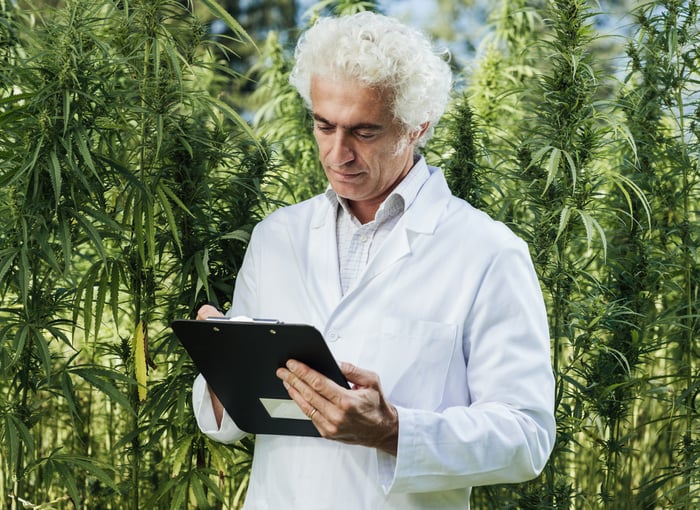
A researcher in a white lab coat making notes on a clipboard in a hemp grow farm.
IMAGE SOURCE: GETTY IMAGES.

Having previously broken its promise, the DEA appears to have changed its tune

The interesting thing here is that changes the Obama administration made in 2016 were designed to rectify researchers' inability to get their hands on federally approved medical cannabis. The Obama administration set a path by which the National Institute on Drug Abuse would license additional cultivators, ending the University of Mississippi's monopoly on federally grown cannabis, which it's held since 1968. In doing so, the supply for researchers to conduct laboratory and clinical studies should increase.
But that hasn't happened. Despite receiving roughly 25 applications for federal cannabis grow farms last year, the U.S. Drug Enforcement Agency (DEA) and Attorney General Jeff Sessions have sat on these applications without approving a single one. In fact, the amount of cannabis the DEA requested be grown in 2018, 443,680 grams, is actually a modest decline from what the drug regulatory agency requested be grown in 2017.
The good news is that it appears the DEA is done breaking promises to researchers and the American public. According to a new register filing from the DEA, as reported by Forbes, the regulatory agency is calling for 2,450,000 grams of cannabis next year "to meet the country's medical, scientific, research, industrial, and export needs for the year and for the establishment of reserve stocks." For those of you keeping score at home, that's a 452% year-over-year increase in requested production.
What we don't as of yet know is where this new production will come from. It's possible it could come entirely from the University of Mississippi in order to replace reduced reserves. It's also just as likely that this proposed 2.45 million grams of production implies that Sessions and the DEA plan to approve some of the grow farm applications they've received. Though Sessions hasn't tipped his hand one way or the other, he's certainly received bipartisan pressure from lawmakers in Washington to boost federally approved output. 
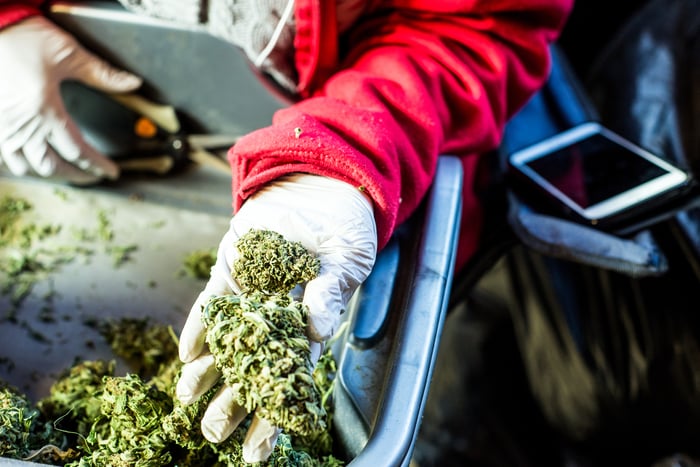
A cannabis processor holding a freshly trimmed bud in their left hand.
IMAGE SOURCE: GETTY IMAGES.

The big picture: Marijuana remains stuck in neutral

But when looking at the bigger picture, the U.S. cannabis industry is unlikely to see much in the way of change, even with the DEA requesting additional production for research purposes. That's because Republicans are still in control of the legislative branch of the federal government, and the GOP has a markedly more negative view of cannabis than Democrats or independents. That makes any chance of a rescheduling or de-scheduling unlikely.
However, there is a wild card that has the potential to incite change at the federal level.
Back on June 25, the U.S. Food and Drug Administration (FDA) approved GW Pharmaceuticals' (NASDAQ:GWPH) Epidiolex to treat two rare types of childhood-onset epilepsy known as Dravet syndrome and Lennox-Gastaut syndrome. What makes this approval so different from just any other drug approval is that it marked the first time that the FDA OK'd a cannabis-derived drug. Synthetic versions of tetrahydrocannabinol (THC), the psychoactive component of the cannabis plant that gets you "high," have been approved before. But this was the first time a cannabidiol (CBD)-based medicine directly from the cannabis plant was given the green light. CBD is the non-psychoactive cannabinoid best known for its perceived medical benefits.
This is significant because the FDA approval of a cannabis-derived drug contradicts the definition of a Schedule I substance. In essence, a Schedule I substance has no recognized medical benefits -- yet here's this newly approved drug from GW Pharmaceuticals that shows otherwise. This cannabis conundrum may spark a rescheduling of cannabidiol, or perhaps lead to increased discussion of marijuana reform on Capitol Hill.
But make no mistake about it: The hill to climb is steep. Even though the public's opinion has shifted dramatically over the past two decades, the federal government has little reason to consider changing its classification of marijuana.
Sean Williams has no position in any of the stocks mentioned. The Motley Fool has no position in any of the stocks mentioned. The Motley Fool has a disclosure policy.
 

Sunday, August 19, 2018

Ford's Soybean Car

By Roger Biermann
Source: carbuzz.com


Henry Ford revolutionized the motor industry in many ways, most notoriously through the introduction of production line manufacturing. But the man had many other ideas, and in the early 1940s he built a car that utilized soybeans in its construction. The car’s body and fenders were manufactured from a soy, wheat, corn, wheat, flax, and hemp composite, vastly reducing its weight compared to traditionally manufactured vehicles of the time. In addition to its unique construction, it ran on hemp fuel – something that could’ve changed the industry and prompted an early shift away from fossil fuels.
Sadly, World War II struck, and all development was brought to a screeching halt. Allegedly, Ford had millions of acres worth of land for the project, which ended up all being for nothing.