Tuesday, November 6, 2018

Hemp is being touted as the Midwest’s next big cash crop. What would that mean for the environment?

By Walker Orenstein
Source: minnpost.com


Even if the market for industrial hemp becomes viable, don’t expect a green revolution from mass production of the crop.
Industrial hemp has attracted excitement and headlines lately as a potential crop of the future, poised to shower America with a long list of beneficial uses in textiles, biofuel, personal-care products and food. It’s also a source of cannabidiol (CBD), a trendy product billed as a cure-all for everything from headaches to chronic pain and anxiety.
One cannabis-related media group billed hemp as the “next biggest cash crop,” while Pacific Standard Magazine recently wondered if it could be “a lifeline for struggling farmers.”
In a bid to find out if those statements are true, Minnesota and at least 38 other states are currently allowing some form of the crop’s production, according to the National Conference of State Legislatures. A state-run pilot project authorized in Minnesota in 2015 has been exploring the crop’s potential as an alternative to corn and soybeans as the state looks to diversify its agriculture industry and boost the environment, particularly water and soil quality.
But even if the market for industrial hemp becomes viable, don’t expect a green revolution from mass production of the crop. While researchers in Minnesota say growing industrial hemp could have some environmental benefits compared to existing cash crops, it may not offer a huge departure from the status quo.
“My take is that it’s pretty much equivalent to corn,” said Donald Wyse, a professor at the University of Minnesota and a leading researcher for the U’s Forever Green project, which is dedicated to expanding the state’s current stable of profitable crops with an eye on enhancing soil and water health.

Some environmental benefits

The Forever Green initiative focuses on developing winter annual and perennial crops like Kernza and Pennycress to supplement traditional summer crops like corn. When a farmer only grows summer annuals, the land can be empty for much of the year, which leaves it vulnerable to erosion and makes it easier for fertilizer and other chemicals to find their way into water.
Wyse said Forever Green is not studying hemp because it’s also a summer crop. Historically, farmers planted a mix of perennial and annual crops, but the agriculture industry has largely moved toward planting only summer annuals. “Adding another summer annual doesn’t add a lot of ecosystem services to that landscape we’re trying to produce,” Wyse said.
While hemp may be grown in the summer like corn and soybeans, George Weiblen, a professor at the U’s Department of Plant and Microbial Biology, said it still may have some environmental positives compared to the two main cash crops, corn and soybeans. Weiblen said he has been researching hemp at the university since 2002 and leading field and lab tests on hemp as part of the state pilot project.
Weiblen said hemp grows fast and dense, so much so that it can “outcompete weeds” better than corn and soybeans. Hemp can also be planted relatively late in season, Weiblen said, meaning farmers can till aggressive weeds in the early spring and then plant hemp on top of them.
Taken together, that means, under the right conditions, farmers could avoid using herbicides entirely, Weiblen said.
Hemp, unlike it’s better known cousin, marijuana, does not have enough THC — the main psychoactive component in pot — to get anybody stoned. Yet it does have cannabinoids and terpenes, naturally occurring chemicals in hemp that deter insect pests, Weibler said, leading to “very little need to control for pests here in Minnesota.” Hemp is “naturally chemically defended,” he said.
A third positive Weiblen has observed: Hemp appears to be popular with bees. When the plant’s flowers bloom, fields are full of them, Weiblen said. Away from the fields, biodegradable hemp products can be used instead of plastics, Weiblen said.
Still, Weiblen said he hasn’t found much evidence to back up some environmental benefits of hemp touted by supporters. Two of those claims are that hemp grows well in poor soil and that it cleans the soil of toxic material, Weiblen said. (Farmers in Italy have been trying to use cannabis to remove toxins from soil, and it was deployed for the same purpose after the Chernobyl nuclear disaster.)

Weiblen also said hemp needs moisture and nitrogen fertilizer just as much as corn and soybeans.

Finding a market

There is another big barrier to reaping any large-scale benefits from hemp: Farmers must be able to sell the product. And despite its buzzy reputation, there have been growing pains for the hemp market.
Professor Burton Johnson, a lead researcher at North Dakota State University for that state’s hemp growing pilot project, said participation increased between 2016 and 2017, but fell the next year. Prices have dropped since the program began, too, he said. Johnson blamed both in part on the difficulty of selling hemp outside North Dakota.
Due to hemp’s association with marijuana — which is still a controlled substance and can only be grown with authorization from individual states — regulations on the market are tight, depressing outside investment, Johnson said. Each state has its own set of rules for what can be done with industrial hemp and there are federal restrictions on buying and selling hemp seeds and products.
“We can grow it, it grows fairly well, but if we can’t sell it easily that’s a problem,” Johnson said.
Johnson said more research and economic development is needed to create a real market for the product. For example, “farmers don’t have the equipment to be CBD oil extractors with hemp” or to process the plant fibers, which can be used in textiles.
Weiblen echoed those concerns, saying “no one is making money growing hemp right now in the United States” because of  a lack of market demand and a reliable supply chain.
“We’re in one of those chicken and egg situations,” he said. “There are many products that can be made from hemp, but they can’t be produced unless there’s a reliable supply.”
Weiblen also said he was unsure if the booming CBD market is sustainable, calling it a “fad” standing on uncertain legal ground. CBD products claim to offer relief from a remarkable range of maladies, including pain and anxiety.
Johnson and Weiblen said they are still optimistic about hemp becoming a part of the Midwest’s rotation of crops, especially because Canada has had success growing the plant since it was legalized in 1998.
Congress could substantially help the industry by legalizing it nationwide, an idea approved in the GOP-led U.S. Senate this year, but one that hasn’t made it to the president’s desk.
“It can be part of a more diverse mix,” Weiblen said. “Is it the next corn or soybeans? I doubt it.”

Canada’s hemp farmers suggest tax to fund national promotion, research

Source: hempindustrydaily.com


Some Canadian hemp farmers want to see their country capitalize on hemp’s trendiness by starting an agency to promote the plant’s health benefits and research better ways to grow it.
The farmers want to tax their hemp sales at 0.5%, with the money going to fund promotions and research, similar to commodity checkoff programs commonly used in the United States.
The Farm Products Council of Canada has agreed to consider the proposal at a hearing in January. Written opinions are due Nov. 24.
If the growers make a good case, the Farm Products Council could recommend the hemp checkoff, better known in Canada as a levy, to Canada’s Minister of Agriculture. A federal Cabinet would make the final decision.
Jason Green, head of agriculture for Ontario-based Canopy Growth, is among the pro-tax farmers.
“This permission … will allow hemp producers to use the 2018 crop to learn more about harvesting, drying and storing whole plant material,” Green said in a statement.
Don Dewar, who has grown hemp off and on for about 20 years in Dauphin, Manitoba, told Hemp Industry Daily that the nascent hemp industry needs to promote hemp food products while the trend is hot.
“We need the demand to increase, and to do that, we need research into the food side,” he said.
“I’d rather grow hemp than wheat; wheat doesn’t make you any money. What we want to do is spend a little money on the research and promotion so we can keep the hemp prices up.”
Dewar is uncertain how much money the hemp tax would produce in a country that grew roughly 138,000 acres of hemp in 2018, almost all of it for seed.
The ad hoc pro-tax hemp group has the support of the Canadian Hemp Trade Alliance but isn’t being promoted by the trade group, Dewar said.
Not all hemp farmers in Canada back the idea; some fear the levy could cut into profits.
But Dewar hopes to persuade the Farm Products Council that Canada needs to enhance hemp support to distinguish the crop from marijuana – especially now that recreational MJ is legal.
Hemp growers would eventually like to be regulated by Canada’s Department of Agriculture and Agri-Food, not Health Canada, which regulates all cannabis now.
“We have spent 20 years trying to divorce hemp from marijuana, and not successfully,” Dewar said. “People still joke about us growing hemp and smoking our crop.”

Cannabis cousin also enters new age

By Terry Fries
Source: producer.com


As cannabis basks in the glow of the first weeks of legalized recreational sale, its close cousin hemp is coming through its own year of change.
Ted Haney, executive director of the Canadian Hemp Trade Alliance, said hemp growers are going through a year in which they are learning how to work with new rules that were introduced in August.
Those permit hemp growers to sell leaves, buds and flowers from hemp plants, which in the past, they would have blown out the backs of their combines as chaff.
Haney said the next step is getting government to remove the restrictions that require these products to be handled only by licensed dealers.
He said hemp-derived cannabidiol (CBD) should be handled differently than the product containing THC, but Health Canada treats them the same.
“Yet the risk profiles of the products are so dramatically different that it, from our perspective, is not a common sense approach,” he said.
“So that’s a very narrow, very conservative and very risk-adverse, precautionary principle approach to regulation.”
The common sense approach would allow for CBD extraction in both streams, he said, with hemp-derived CBD to be guided by regulations for food and supplements.
Oct. 17 was the first day hemp growers were allowed to deliver the buds, flowers and leaves they collected as regulations surrounding the legalization of recreational cannabis took effect.
Growers are permitted to sell those products only to licensed processors certified to handle regular cannabis, even though hemp contains less than 0.3 percent THC, the chemical that produces the high effect.
“There were several large, small and medium producers who did harvest the chaff this year. Others are still in harvest as we speak because of the snow and the rain,” Haney said in mid-October.
The leaf, bud and flower parts of the plant are sought after for their CBD, a naturally occurring compound in hemp.
The term cannabinoid refers to several naturally occurring compounds in the plants, including cannabidiol and THC. CBD is used in medical marijuana in combination with THC in drops and other delivery forms to treat pain and anxiety, as a sleep aid and as an anti-inflammatory.
Hemp-derived CBD is used as a health food ingredient with no specific health claims in bars, supplements, cereals and other products.
Haney said the lengthy and expensive process for processors to get proper licensing, and the added security costs required for producers and processors of THC-containing products, are unnecessary for the hemp-derived products.
He said the hemp industry plans to make its position clear during Health Canada’s public consultation period on cannabis edibles, which are slated to become legal next year.

Is CBD Good for You?

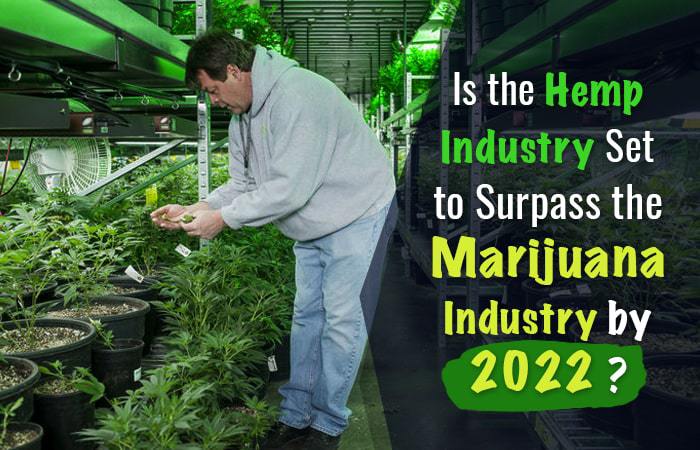
Is the Hemp Industry Set to Surpass the Marijuana Industry by 2022?

Source: marijuanabreak.com

How hemp could be set to overtake marijuana as the industry leader

Is the Hemp Industry Set to Surpass the Marijuana Industry by 2022?

The growth of the legal marijuana industry has exploded in recent years; aided by the full legalization of weed in California at the beginning of 2018. Despite all the trials and tribulations, cannabis lovers in the United States are fortunate to be living here rather than the majority of nations in the world. Weed is now legal either medicinally or recreationally in 30+ states plus D.C.
In 2017, before recreational legalization in California, the U.S. accounted for 90% of the world’s legal cannabis market! One would expect a slight reduction in market share now that Canada has fully legalized the herb. For the record, our northern neighbor’s market share was just 6% in 2017.
With a Gallup Poll from October 2017 showing that 64% of Americans now support full legalization of medicinal marijuana, the wind is very much at the backs of the cannabis industry. However, the market has an unexpected challenger.

The Rise of CBD & Hemp

Hemp and marijuana both come from Cannabis sativa, one of the three main phenotypes of the marijuana plant. However, they are very different in many ways, including one crucial aspect which gives hemp a decided edge. As you know, marijuana contains THC, the psychoactive compound that helps you get high. In contrast, hemp contains less than 0.3% THC in general, but is filled with cannabidiol; a non-intoxicating compound purported to have a variety of health benefits.
As a result, CBD can be used by children. Crucially, CBD extracts are legal in almost every state, and new legislation could result in the complete legalization of hemp. The Hemp Farming Act was introduced by none other than Mitch McConnell, the Senate majority leader, which means it has significant bipartisan support – a rarity in the current political climate.
If and when the Hemp Farming Act passes, which looks extremely likely, hemp will be removed from the federal list of controlled substances which will ensure it can be grown and sold as an ‘agricultural’ product. This means consumers in states where marijuana is illegal can use CBD-rich hemp for medicinal purposes.
As a consequence, there is every chance that the hemp market could outstrip its marijuana cousin within just a few years. A report released by the Brightfield Group showed that CBD market sales were likely to reach $591 million in 2018. However, it is set to surge to $22 billion by 2022.
According to a report by BDS Analytics and ArcView Market Research in 2017, Canopy Growth became the first $5 billion cannabis company. The global market was worth approximately $9.5 billion and will reach $23.4 billion by 2022. Of course, we can’t assume that these reports will prove accurate; After all, they were created before the introduction of the Hemp Farming Act. It also doesn’t consider the possibility of marijuana being fully legalized in several states by that time.

Hemp Market Moves

Judging by the size and frequency of moves in the hemp market, the $22 billion estimate by 2022 could prove to be conservative. The CBD-infused soft drink market is arguably one of the most interesting potential sub-markets. According to Grand View Research, the global carbonated soft drinks market will be worth over $600 billion by 2025, with an emphasis on healthy, sugar-free beverages.
CROP Infrastructure recently announced plans to create a new line of cannabis-infused drinks called CANNADRINK. It is unclear if this beverage will contain THC, or whether it will be a drink only rich in CBD. Given the legal issues surrounding marijuana in many American states, we would assume it will be the latter.
The list of potential CBD-infused products likely to hit the market in the next few years is lengthy. Already, edibles, creams, chewing gum, and niche drinks are available. There are even a handful of breweries that specialize in CBD beer!
The vast potential of the hemp market has already resulted in significant moves by major corporations. The main drivers of growth, aside from imminent legalization of hemp, include the popularity of hemp CBD against pharmaceutical products, increased investment, the evolution of distribution channels, and a more diverse range of products.
Only a few years ago, the best way to get CBD was via tinctures which were sold online or in smoke shops. Today, there are dozens of CBD products. It seems as if natural food stores are struggling to fill their shelves quickly enough, and you can also find hemp products at gyms and massage spas. Once legalization is complete, major retailers such as Target, Walmart, 7-Eleven, and Whole Foods will begin selling hemp products.
Meanwhile, hemp sellers such as Elixinol already see the benefit of market growth. In the first half of 2018, the seller of industrial hemp products announced a profit of almost $15 million, an increase of 110% when compared to the first half of 2017. The firm has also engaged in a joint venture which sees the expansion of an industrial hemp production facility in Colorado from 8,700 square feet to 20,700 with plans for a further 20,000 square feet worth of expansion.
The cannabis market isn’t resting on its laurels either, however. Aphria Inc. and Emblem Cannabis Corp. have entered into a wholesale supply agreement. The former will supply the latter with an incredible 175.000 kilograms of premium quality marijuana over a five-year period beginning in May 2019. HEXO Corp. has announced its interest in the acquisition of a 2 million square-foot facility in Belleville, Ontario.

Final Thoughts on the Growth of the Hemp Market

In answer to the original question, we have to say “we’re not sure.” Initial projections place the hemp and cannabis markets almost neck and neck, with the latter probably enjoying a slender lead in 2022. However, there is no way of knowing what will happen in the next four years.
About the only certainties are that both markets will expand exponentially and that the Hemp Farming Act will pass, whereas cannabis will not be made federally legal within that time-frame. We also expect an increased range of products, better supply lines, and further research indicating the efficacy of hemp and cannabis for treating a variety of medical conditions.

THC! CBD! TERPENOIDS! CANNABIS SCIENCE IS GETTING HAIRY

By Matt Simon
Source: wired.com


Getty Images

TODAY, CANNABIS CONTINUES its slow march toward nationwide decriminalization with voters deciding whether to allow recreational use in Michigan and North Dakota, and for medical purposes in Utah and Missouri. As states keep chipping away at federal prohibition, more consumers will gain access, sure—but so will more researchers who can more easily study this astonishingly complex and still mysterious plant.
At the top of the list of mysteries is how a galaxy of compounds in the plant combine to produce a galaxy of medical (and, of course, recreational) effects. For example, THC feels different when combined it with cannabidiol, or CBD, another naturally occurring compound in cannabis, but the reasons aren’t fully known. It’s called the entourage effect: THC, like a rock star, only reaches its full potential when it rolls with a crew, consisting of hundreds of other compounds in the plant that scientists know about so far.
But the problem with researching a schedule I drug is that the government doesn’t want you to do it. Yet as more states go legal, cannabis continues to climb out of the scientific dark ages. Because it’s not just about giving people a comfortable high, but about developing cannabis into drugs that could treat a massive range of ills.
First, some cannabis basics. THC and CBD are cannabinoids, which means they bind to receptors in the human body’s endocannabinoid system, specifically the CB1 and CB2 receptors. Researchers only discovered the endocannabinoid system in the early 1990s, but it appears to regulate things like mood and immune function.
You may have noticed that cannabis’ effects can differ wildly from experience to experience. Eat a weed brownie, for instance, and the THC goes straight to your liver, where it’s metabolized into 11-hydroxy-THC. That metabolite “has five times the activity at the CB1 receptor, the psychoactive one, as THC itself,” says Jeff Raber, CEO of the Werc Shop, a cannabis lab in California.
That’s why it’s so easy to overdo it with edibles. When you smoke cannabis, the THC at first skips the liver and goes straight to your bloodstream. It’s about five times less potent that way than if you eat cannabis, meaning that chowing down on 10 milligrams of THC is roughly equal to smoking 50 milligrams of the stuff.
Mode of ingestion, then, is a big consideration in the cannabis experience. But so too are factors beyond your control. “We're pretty aware that the endocannabinoid system is not a static picture throughout the day,” says Raber. “Why it changes, what causes those changes—those are other levels of complicated questions.” Cannabis might hit you differently during the day than at night, and can also depend on your mood or whether you’ve eaten.
But that’s not all. THC also interacts with other cannabinoids in your system, and it has a complicated relationship with CBD in particular. Anecdotally, cannabis users have reported that CBD can modulate the psychoactive effects of THC—think of it sort of like an antidote to the paranoia and anxiety that comes with being too high. That might be part of the reason edibles can feel so powerful: If you eat a brownie loaded with just THC, you aren’t getting the CBD you would if you smoked regular old flower. (Not that some manufacturers aren’t also adding CBD to their edibles. CBD is so hot right now, but it's hard to find flower with high CBD. Cultivators have over the decades bred highly intoxicating, THC-rich strains at the expense of CBD.)
With cannabis growing more legitimate as a medicine, researchers are finally putting hard data to these anecdotal reports. They’re beginning to understand how CBD might modulate the often unwelcome effects of THC.
Consider the drug Marinol, a synthetic form of THC available since the 1980s. It’s a good appetite stimulant, but it’s also good at getting patients high and paranoid. “When you just stimulate the CB1 receptor with this pure molecule, it's very intoxicating and patients don't tolerate it very well,” says Adie Wilson-Poe, who researches cannabis for pain management at Washington University in St. Louis.
However, give patients a drug like Sativex—which combines THC with CBD—or even pure cannabis flower or extracts, and they tolerate it much better. “We specifically see that CBD protects against the paranoia and anxiety and the racing heart that THC produces,” Wilson-Poe says.
It all comes back to the psychoactive CB1 receptor. THC is an agonist that fits nicely into CB1, activating it. “CBD can't do that at the CB1, but it does sort of sit in the pocket,” says Wilson-Poe. “It can compete with THC for the spot in the receptor.” Which means that if you take CBD with THC, there may be fewer receptors available for the THC to activate, thus modulating the psychoactive effects, like paranoia.
“But that's probably not the whole story,” Wilson-Poe says, “because CBD has at least 14 distinct mechanisms of action in the central nervous system. So it does a little bit of something at a whole bunch of places, and we probably can't attribute the anti-paranoia or anti-anxiety effects just to CB1 occupancy.”
Now let me add yet another complication to our growing list of complications: THC and CBD are far from alone in the cannabis plant when it comes to medicinal properties. Those two might be anti-inflammatory, for instance, “but if you were to vaporize a whole flower, you'd be consuming potentially a couple dozen anti-inflammatory molecules at once,” says Wilson-Poe. “In this sense I think of whole-plant cannabis as like a multivitamin for inflammation.” (Because there are so many important compounds at play, some researchers prefer the term ensemble effect over entourage effect. “Entourage” makes it sound like everything is supporting the rock star that is THC, when the reality might be more nuanced.)
There might also be medical applications when you don’twant the entourage effect at work. One of THC’s more famous treatments, for instance, is for lowering eye pressure to treat glaucoma. “We found that it works, and THC does a nice job,” says Indiana University, Bloomington researcher Alex Straiker, who studies cannabinoids. “But it's actually blocked by CBD. People often think, oh yeah, CBD and THC work together. But in terms of CB1 receptor signaling, they actually oppose each other, or at least CBD opposes THC.” That’s not to say, though, that CBD isn’t having some sort of beneficial effect on its own when it comes to treating glaucoma.
Plus, there are many other kinds of receptors in the endocannabinoid system that these compounds could be targeting. “It's messy,” Straiker says.
So while CBD seems to mitigate the unfun effects of THC, it also might get in the way of certain medical benefits that THC has to offer. But because there’s seemingly no end to the complexities of cannabis, CBD might also enhanceTHC’s anti-cancer properties. Research has found that if you apply THC and CBD to cancer cells in the lab, the combination is more effective than THC alone at both inhibiting the growth of those cells and outright killing them. The future of medical cannabis, then, depends in large part on teasing apart the entourage effect—leveraging it in some cases, and maybe breaking up the entourage (or ensemble) when THC or CBD alone is most beneficial.
“We need to understand which constellations of plant chemistry are best suited for which indications and which kinds of patients, and which form of the CB1 receptor you happen to carry, because there are lots of mutations in that gene,” says Wilson-Poe. “So understanding these mechanisms is absolutely crucial for providing these patients with personalized medicine that alleviates their symptoms without producing the unwanted side effects.”
Hate to do this, but we’ve got one last problem. For decades, cannabis users have claimed that different strains of cannabis produce different effects—maybe it makes them sleepy, maybe it gives them energy. And that’s been true even as CBD was largely bred out of cannabis in North America in favor of THC. “Well, if they're all high THC, it's got to be from something else,” says Ethan Russo, director of research and development at the International Cannabis and Cannabinoids Institute, who studies the entourage effect. “And that something else is terpenoids.”
Yes, another member of the entourage. Unlike THC and CBD, you can find terpenoids not just in cannabis, but across the plant kingdom. They’re handy little molecules that plants use to ward off insects, and they’re what give cannabis that characteristic smell (same for terpenoids in lemons and pine needles).
And science knows what some terpenoids found in cannabis do pharmacologically in the brain. For example, linalool is one that has sedating and anti-anxiety properties. “So it might make sense that when you combine its anti-anxiety effect with that of cannabidiol [CBD], then they boost each other,” says Russo.
The entourage effect, the ensemble effect—whatever you want to call it, the phenomenon might get more complicated before it gets clearer. But researchers continue to tease apart the chemistry of cannabis, unlocking its true potential as a medicine. Mystery … almost solved.