Sunday, June 3, 2018

By Ted Stanton
Source: ministryofhemp.com
 
Many people assume that CBD is a rather new and innovative supplement, but CBD history actually goes back much further.
Actually, CBD as we know it today has been around for more than half a century. Let’s take a look at this chemical compound’s interesting history since it was first discovered and the journey it had to go through to become what it is today.

CBD HISTORY BEGINS IN THE 1940s

The first person who was successful in extracting CBD from the Cannabis sativa plant was a chemist who graduated from Harvard university, Roger Adams. However, when Adams first managed this in 1940 he wasn’t aware that he succeeded in extracting a chemical compound and didn’t even know what he had done. Years later, Adams and other scientists realized what he had done and started researching the possible benefits of CBD.
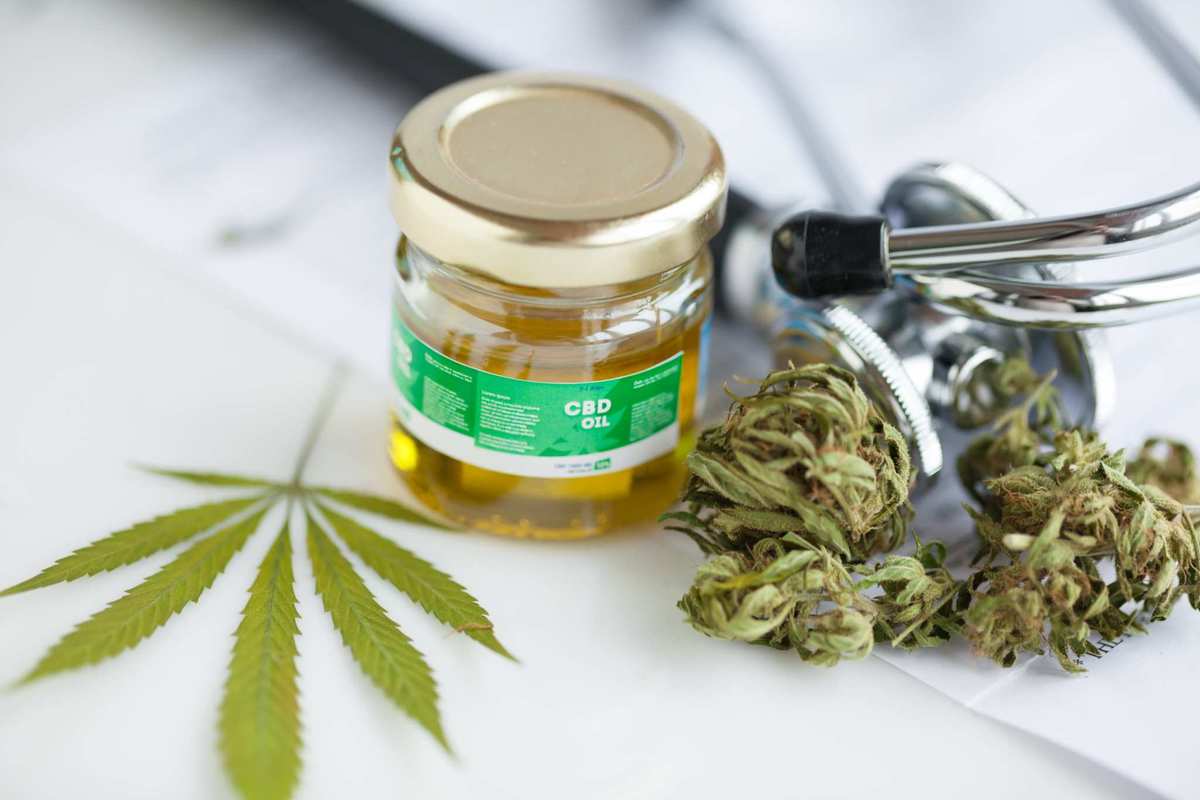
Most people consider CBD oil a modern discovery, but CBD history stretches back to the 1940s.
 
Modern CBD history begins in 1946, when Dr. Walter S. Loewe conducted the first CBD test on lab animals. These tests gave proof that CBD doesn’t cause an altered mental state. That same year Dr. Raphael Mechoulam identified CBD’s three dimensional structure and that’s why he’s often credited as the scientist who discovered CBD. Further research continued in the 1960s on primates and finally, the first CBD oil meant for therapeutic use was released by the British Pharmacopoeia.
In the next few decades, the research continued. In 1980, Dr. Mechoulam made another breakthrough in CBD history when he ran a study which showed cannabidiol could be a key factor in treating epilepsy.

HOW CBD IS USED TODAY

Today, the stigma surrounding CBD is starting to disappear as people are finally beginning to see its true potential.
Although CBD supplements and products are legal in all 50 states, there are cases in which it isn’t legal. The main factors in regards to its legality depends on a number of important factors determined by each specific state. The one crucial factor across all states is in relation to where the CBD is derived from, marijuana or hemp.
Even though CBD supplements made from industrial hemp are legal in all 50 states, there have still been some legal challenges. Major progress happened in 2014 when Alabama, Florida, Iowa, Kentucky, Mississippi, Missouri, North Carolina, South Carolina, Tennessee, Utah, and Wisconsin passed laws legalizing CBD for medical purposes. It’s also legal as a supplement in the UK and many other countries around the world.

Today, CBD is used to relieve symptoms of numerous conditions,
from anxiety and mental illness to chronic pain.
 
When it comes to healing, people use products such as CBD oil, CBD water and various CBD lotions to try and treat pain, inflammation, depression, anxiety, stress and other illnesses. It’s commonly used by athletes to help relieve their bodies after workouts and performances, by people suffering from mental illnesses to calm their symptoms down and many others. Some people even replace classic painkillers and other medication with CBD products, claiming that they have a better effect and treat their symptoms quicker with little to no side effects.

THE FUTURE OF CBD

Nobody can know for sure what the future will bring but we can always be optimistic.
Since more and more people are seeing the benefits of CBD and hemp, it looks increasingly likely that hemp will be fully legalized in the U.S. soon. Scientists are still researching CBD and conducting experiments that reveal its beneficial uses. For now, it’s been discovered that CBD may be beneficial for treating arthritis, insomnia, epileptic seizures, diabetes and many other illnesses.
There are many organizations that are lobbying for the total legalization of hemp and they just might succeed.
 

How Hemp Could Save Farmers Across the United States

By Joseph Misulonas
Source: civilized.life

How Hemp Could Save Farmers Across the United States

Hemp farming has become a popular discussion in some political circles in recent months, but it's not just some fad. It could legitimately save farmers across the United States.
There are many reasons hemp can be beneficial to American farmers. Unlike marijuana, hemp can be grown in large quantities outdoors, similar to wheat, corn or soybeans. It is also more adaptable than other major crops. Hemp requires only half as much water as corn, which saves farmers money, can be grown in a variety of different temperatures and soils, doesn't need pesticides and can grow incredibly fast.
Many point to water conservation as a major selling point for hemp farming. In areas with dry or arid environments, like the American southwest, water is incredibly scarce and will probably become even more so in the coming years thanks to climate change. Hemp could therefore become a vital part of a farmer's life in these areas.
It also helps that hemp can be grown for any number of reasons. CBD products would be one major use of hemp, but there are supposedly 25,000 uses for the crop including biodiesel, paper, fabric and building materials.
Right now, farmers who do grow hemp in the United States make around $90,000 per acre. To put that in perspective, alfalfa (America's fourth largest crop) makes only $600. Although part of that is that there are so few hemp farmers that demand is incredibly high. Last year, hemp farming took up only 25,000 acres in the United States. Alfalfa had 16.5 million.
All this is to say that it's pretty undeniable that allowing hemp farming would be incredibly valuable in the United States. And considering even anti-marijuana Republican Senate Majority Leader Mitch McConnell believes hemp farming should be allowed, it's pretty likely it's going to happen.
 

It's not weed; it's industrial hemp. Can it make a comeback in Iowa?

By Danny Lawhon
Source: desmoinesregister.com

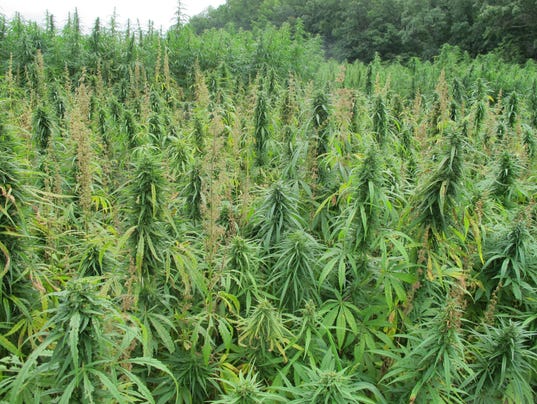
636627579277125369-hemp2.JPG
The cultivation of industrial hemp received unanimous passage in the Iowa Senate this past legislative
session but stalled in the House.

The momentum for legalizing industrial hemp in America is building. Iowa supporters of the once-prevalent crop, though, have moved on from being eager about its possibilities to anxious to get growing.
Hemp got lumped in with its infamous sibling cannabis crop, marijuana, when it was made illegal to grow in the U.S. without a permit in 1970. But hemp doesn't get you stoned, since it contains negligible amounts of tetrahydrocannabinol, or THC. 
In the past five years, the plant has been making a quiet comeback in America. At least 35 states nationwide now allow some form of industrial hemp cultivation, and U.S. Senate Majority Leader Mitch McConnell, R-Ky., wants hemp federally descheduled — meaning states could carry out changes without interference — as part of the latest Farm Bill. But that massive, catch-all legislation is caught up in bureaucratic snags.
A research and exploration bill for hemp passed the Iowa Senate unanimously this past legislative session, too, but talk in the House quieted after it was OK'd by a subcommittee.
Some Iowa farmers such as 34-year-old Ethan Vorhes, who helps oversee land a few miles south of Charles City, are tired of waiting. He thinks the crop could stand as a companion to corn and soybeans in Iowa's rotation. After all, tens of thousands of acres of hemp were raised here during World War II. Plus, the plant has uses in more than 25,000 products, from fibers, textiles, paper and construction materials to beauty products, food and beverages.
It can serve as animal feed, which Vorhes said would raise the profile of his farm's stock of cattle raised for kobe beef. Numerous studies are showing that hemp requires minimal amounts of pesticides and does little to impede soil health.
Growing hemp can increase corn and soybean yields the following year by an average of six and four bushels per acre, per the Iowa Hemp Association. 
"I want to be able to revolutionize a family farm," Vorhes said. "Hemp can help us change part of that situation in the field."
Hemp is no wonder crop, but it offers enough financial options to let individual farmers dream beyond their staples. It's expected to be a billion-dollar industry nationally by 2020, according to a report from the Brightfield Group, a Florida-based analytics firm.
And for the past several years, entrepreneurs have been lining up for small-business loans to find their place on the business' front porch. They've come from several states to people like Charles Wellso, a co-founder of Colorado-based Sanitas Peak Financial LLC who grew up in Cedar Rapids, for getting that start.
 "Rarely do you get an opportunity to build a national business," Wellso said. "Hemp is one of those things that offers people with ability to use hard work and talent to really make great returns. The opportunities are dramatic."
For individuals, perhaps. For a state as a whole, maybe not so much. Iowa State University agricultural economist Chad Hart cautioned that hemp's potential doesn't mean you'd see marijuana's sibling running wild.
He compared the billion-dollar hemp potential with the $40 billion national soybean market and the $60 billion that comes from corn. He concluded that farmers won't be moving to hemp in droves.
Hart sees hemp as a larger-scale version of the switchgrass fad, considered a viable component for ethanol production around the turn of the century but one that never became a must-have investment.
Hemp has been legal in Kentucky since 2014, and the latest profit measurements from 2016 were around $5 million over 2,320 harvested acres. The issue, Hart said, isn't about production, but rather the marketing and the utilization.
"Could farmers produce a lot of it (if hemp is legalized)? Yeah," he said. "But unless I have an active market demanding the product, just because I can doesn't mean I should. That's the challenge."
But in Iowa, the pro-hemp bill stalled in the Iowa House of Representatives after making its way through a Ways and Means subcommittee in early April.
State Rep. Lee Hein, R-Monticello, who chaired the subcommittee, said the lack of passage this year had to do more with time than anything else. The House was working on an amendment to address funding for two state initiatives: the Industrial Hemp Commodity Program, administered by the Iowa Department of Agriculture and Land Stewardship, and the Industrial Hemp Production Program, administered by a Board of Regents institution.
He added that numerous discussions involving medical marijuana in the Legislature over the past several years have helped differentiate hemp from the overall cannabis discussion.
"They're two separate issues," Hein said.
Retiring Ways and Means chairman Guy Vander Linden, R-Oskaloosa, said that broad bipartisan support for the Senate bill indicates that hemp approval could come as early as the 2019 legislative session — depending the political makeup of both houses, of course.
"A little diversification (in crops) may not hurt anybody, and the lobby made a pretty good case that this is something to consider," Vander Linden said. "So I think it's got legs for down the road."
For now, though, farmers waiting to enter the market are broadening their own horizons. Vorhes, for example, is attending a conference in New York in early June, on his birthday, and is contemplating transplanting parts of his operation where he can take advantage of the hemp culture now. 
"I don't think Iowa can wait but another year," Vorhes said. "Otherwise, you might start to see things take root somewhere else.
"It hurts every day that we wait."

Get hip to hemp

Some quick facts about marijuana's sibling crop:
  • It's been illegal to grow in the U.S. without a permit since 1970, when the Controlled Substances Act was passed.
  • At least 35 states nationwide now allow some form of industrial hemp cultivation overseen by a state board or regulatory organization.
  • Hemp is one of the earliest known plants to be cultivated, dating to Japanese islands around 8,000 B.C.
  • America's first president, George Washington, pushed for hemp growth and grew the crop himself. Andrew Jackson, Thomas Jefferson, James Madison, Franklin Pierce and Zachary Taylor are other presidents who have farmed hemp.
  • Tens of thousands of acres of Iowa farmland were used to grow hemp during World War II for making uniforms, canvas and other materials.
  • Technically, hemp is part of the same species as marijuana (cannabis sativa). The main difference between the two is that hemp doesn't get you high, since it contains only trace amounts of tetrahydrocannabinol, or THC.
  • A research and exploration bill for hemp passed the Iowa Senate unanimously this past legislative session, but talk in the House quieted after it was approved by a subcommittee. Prospects for future passage appear optimistic. 

DEA says it Won’t Prohibit Cannabis Stems, Seeds for Product Use, Sale

By Joanne Cachapero
Source: mgretailer.com

DEA_Stems_Seeds_mg_magaizne


WASHINGTON D.C. –The Drug Enforcement Agency (DEA) on May 22 issued an internal directivethat apparently acknowledges some cannabis products are not currently prohibited under the Controlled Substances Act (CSA) and that specific parts of cannabis plants are not prohibited for use under current policy.
According to the directive, the DEA’s enforcement policy is consistent with a 2004 decision handed down by the U.S. Ninth Circuit Court of Appeals, in Hemp Industries Association v. DEA.
The directive stated:
“Products and materials that are made from the cannabis plant and which fall outside the CSA definition of marijuana (such as sterilized seeds, oil or cake made from the seeds, and mature stalks) are not controlled under the CSA. Such products may accordingly be sold and otherwise distributed throughout the United States without restriction under the CSA or its implementing regulations. The mere presence of cannabinoids is not itself dispositive as to whether a substance is within the scope of the CSA; the dispositive question is whether the substance falls within the CSA definition of marijuana.”
The directive also said that the policy directive did not change the DEA’s current policy toward cannabis extracts and resin.
Cannabis law firms reacted to the directive, which in effect, potentially clears the way through the dense legal grey area for CBD or hemp-based products, and could signal a boon to cannabis/hemp growers and product manufacturers.
Canna Law Blog™ refined the definition of parts of cannabis plants that the DEA has said are exempt for use in product manufacturer. They include:
  • Mature stalks
  • Fiber produced from mature stalks
  • Oil or cake made from seeds
  • Seeds incapable of germination
The DEA directive also said that “any other compound, manufacture, salt, derivative, mixture, or preparation” created from named plant parts were also not prohibited, though Canna Law pointed out any extracted resin is still considered “marijuana” by the DEA and would be prohibited under the CSA.
The DEA directive went on to essentially say products produced from non-prohibited ingredients were okay for sale in the United States. Products containing THC, the psychoactive compound in cannabis, and products otherwise designated as marijuana by the DEA were still federally prohibited. Non-THC products, however, would not be prohibited. The directive did not directly address hemp or hemp-based products.
“Such products may accordingly be sold and otherwise distributed throughout the United States without restriction under the CSA or its implementing regulations. The mere presence of cannabinoids is not itself dispositive as to whether a substance is within the scope of the CSA; the dispositive question is whether the substance falls within the CSA definition of marijuana,” the directive said.
Lane & Powell’s The Pipeline Blog said, “… The logical and scientific inconsistency puts the DEA and purveyors of CBD goods in a precarious position: how will they determine which CBD products are subject to the CSA and will people really be prosecuted for trafficking a Schedule I controlled substance where the substance is chemically indistinguishable from one that is not prohibited by the CSA?
“We anticipate that at least one outcome will be buyers insisting on statements or warrantees from sellers, and buyer quality control due diligence, that their CBD products contain only excepted marihuana (sic) oil,” Pipeline blog authors Justin E. Hobson & Lewis M. Horowitz added.

Friday, June 1, 2018

Banned from Wall Street, US cannabis companies go north

By Aaron Smith
Source: cnn.com

Image result for medmen
 MedMen, a Los Angeles-based chain of marijuana dispensaries, can't trade on Wall Street because cannabis is illegal in its home country.
So it listed in Canada.

MedMen started trading this week on the Canadian Securities Exchange, or CSE.
They're not alone. US cannabis companies are heading north to list on stock exchanges in Canada, where there's no federal ban on marijuana sales. Medical marijuana is legal there, and the country is in the process of legalizing recreational marijuana, too.
It's a two-way street. Some Canadian cannabis companies have come south to list on Wall Street exchanges, because they're not subject to the same restrictions that keep US pot growers away.
In the US, medical marijuana is legal in 30 states, and recreational is legal in 10. But US cannabis companies can't list on US stock exchanges or even get basic financial services, because marijuana is prohibited by the federal government.
There are no straight roads and there are no clear paths," said MedMen CEO Adam Bierman.
Chand Jagpal, chief financial officer for Prime Harvest, a California-based cannabis cultivator, said his company is in the process of listing on the CSE through the reverse merger of a company called ME Resource Corp.
"From the Canadian perspective, it's not an illegal activity, from the US perspective, it is," said Jagpal, who's originally from Vancouver.
The CSE is jokingly referred to as the "cannabis stock exchange" because 76 of its 379 companies are in cannabis.
"Yes, yes, we've heard that one," Richard Carleton, CEO of the CSE, said of the nickname. He said he lists companies "operating within the boundaries of what is a tightly regulated state framework."
Some analysts say it's in the best interest of the United States to resolve the legalization issue on a federal level.
"If the US doesn't get its act together and resolve this federal-state conflict, we're going to lose a business that should rightfully be ours," said Troy Dayton, CEO of The Arcview Group, a market research firm in cannabis.

A few Canadian cannabis companies have made it onto American exchanges.
Canopy Growth (CGC), a Canadian cannabis company, started trading on the New York Stock Exchange on May 24.
"You can list here [in the US] if you're not breaking any of the rules in any of the jurisdictions that you operate, and I don't break any rules because I don't operate in any jurisdictions where it's federally illegal, which unfortunately includes the US," said Bruce Linton, CEO of Canopy, which is traded on the Toronto Stock Exchange under the ticker WEED.
MedMen planted roots in Canada in March. The company had conducted a reverse takeover of Ladera Ventures, a shell company already on the CSE, and avoided having to file an Initial Public Offering. It also formed a partnership with Canadian cannabis producer Cronos Group (CRON), which joined the Nasdaq in February.
"It's a very unique system," said Charlie Alovisetti, a lawyer with Vicente Sederberg, which advises investors and businesses in the cannabis industry. "Canadian investment is appealing because it allows you to get your foot in the door in the Canadian cannabis industry, while remaining on the right side of the federal law."
Last year, Constellation Brands (STZ), a US company that owns alcoholic beverage brands including Corona beer, paid $190 million for a 10% stake in Canopy Growth Corp., a Canadian cannabis producer.
The NYSE and Nasdaq declined to comment for this story, but they confirmed that because marijuana is legal there, Canadian cannabis companies are not banned from Wall Street exchanges.
US exchanges are losing out on fees associated with listing, and US banks are losing out on financing, according to Jason Zandberg, an analyst who covers Cronos for PI Financial.
"Exchanges like the CSE are becoming relevant in North America whereas three or four years ago the CSE wasn't even relevant in Canada," he said. "We have seen many businesses that have embraced the cannabis sector and have surpassed their competitors that have not."
There's a lot of money being left on the table with marijuana. The US market is bigger than Canada's, even with federal prohibition.
In Canada, medical marijuana revenues totaled less than $500 million last year, according to New Frontier Data, which analyzes the industry. But that's expected to grow. Lawmakers are working to end federal prohibition of recreational marijuana this year, which could fuel a $6 billion market by 2024, according to New Frontier Data.
But that still wouldn't top the US, where state-by-state marijuana revenues totaled $8.3 billion last year, according to New Frontier Data. It's expected to reach nearly $22 billion by 2025.


Missouri is the latest state to legalize hemp

Source: hempsupporter.com


Another day; another victory for hemp and hemp-derived CBD. This time: The Show Me State.


In one of his final acts in office – his resignation is effective at 5:30 PM today – Missouri Governor Eric Greitens signed HB 2034, into law. Sponsored by hemp heroes Rep. Paul Curtman and Sen. Brian Munzlinger, the bill will establish Missouri as the latest state to legalize hemp and develop a Farm Bill-authorized hemp program.
 
When the bill was originally introduced, it did not specifically exempt hemp products from regulation as a controlled substance, which could have posed a real problem for the industry.  However, an effort led by US Hemp Roundtable board members – and the forward-looking leadership of Rep. Curtman and Sen. Munzlinger -- ensured the insertion of the following language extending hemp’s exemption to hemp products such as hemp-derived CBD:
 
(c) "Industrial hemp" includes industrial hemp commodities and products and topical or ingestible animal and consumer products derived from industrial hemp with a delta-9 tetrahydrocannabinol concentration of not more than three-tenths of one percent on a dry weight basis; 
 
Big thanks go to the following companies that funded the effort:  CV Sciences, CW Hemp, American Shaman, Bluebird Botanicals, Isodiol and Zilis.  Congratulations to the outstanding Missouri firm, Penman & Winton for leading the advocacy effort.  And of course, our deepest gratitude to Rep. Curtman, Sen. Munzlinger and the outgoing Governor for their leadership.


CBD’s legal status remains a conundrum – even for the DEA

Source: hempindustrydaily.com

See the source image

Less than a month after a court decision upheld the U.S. Drug Enforcement Agency stance that CBD is an illegal drug made from marijuana, the agency released a statement clarifying its position and separating hemp-derived cannabidiol from its enforcement.

The DEA’s Diversion Control Division explained to law enforcement agencies that CBD from hemp grown in compliance with federal law falls outside the purview of the Controlled Substances Act.

“Such products may accordingly be sold and otherwise distributed throughout the United States without restriction,” the agency wrote in a bulletin posted last week.

The agency further clarified that hemp products such as CBD are legal to import and export, so long as the product is legal in the country of destination.
The clarification comes in the wake of a federal court decision upholding the DEA’s position that cannabis extracts, including CBD, are illegal drugs that should be treated the same as marijuana.
But the judges pointed out that the Controlled Substances Act does not limit hemp grown in compliance with the 2014 Farm Bill, which allows states to experiment with the crop.
The fact it isn’t possible to tell whether CBD molecules were extracted from hemp or marijuana has led to persistent confusion about the product’s legality.
Earlier this month, Michigan regulators announced CBD will be regulated like medical marijuana. And in Texas, health authorities are mulling a statewide ban on CBD in food products.