Tuesday, May 8, 2018

How Elixinol is Riding the Global Hemp and Cannabis Wave

By Carrie Pallardy
Source: newcannabisventures.com


Exclusive Interview with Elixinol Global Founder and CEO Paul Benhaim


Elixinol Global (ASX: EXL) (OTC: ELLXF), a parent company that includes hemp food, CBD, and medical cannabis businesses, has a far-reaching and growing global presence. Founder and CEO Paul Benhaim, who started working hemp back in 1993, spoke with New Cannabis Ventures about the three different Elixinol Global companies, the company’s recent IPO, and how it is achieving such significant growth.
Benhaim was born in London and first started working in the hemp industry there. His interest in food and nutrition led him to begin the first commercial hemp food business in Europe, which sold millions of snack bars and gained him a reputation in the industry. Benhaim consulted for a number of other companies throughout Europe and North America before coming to Australia to start a hemp food company. It took years for Australian legislation to change, but Benhaim wasn’t idle during that time. He wrote nine books on industrial hemp and created business courses to help others launch successful companies in the space, and eventually he led the opening of a hemp foods manufacturing facility in Australia that became the largest of its kind in the southern hemisphere.
Given Benhaim’s background in the hemp industry and regular international travel, Elixinol Global seems a natural fit. Hemp Foods Australia, which manufactures and distributes industrial hemp‐derived food and skincare products, was formed in the 1990s. Then in 2014, Elixinol US, a CBD company that now accounts for the majority of the company’s sales, was formed. By 2017, that company had grown to $13 million in revenue, up 86 percent from FY 2016. Most of this company’s work is done in the United States, but it does have a hold in other markets. For example, the company has a 10 percent stake in Elixinol Japan, a company formed to work on the legislative environment there and conduct clinical studies.
Respira CBD oil is specially formulated for use as an oral spray. It contains full-spectrum cannabinoids extracted using CO2
Elixinol Premium Medical Cannabis is the third company under the umbrella, and it was this unit catering to the medical cannabis opportunity in Australia that drove the strategic decision to list on the Australian Securities Exchange (ASX). Benhaim estimated it would take approximately $20 million to get his medical cannabis business up and running, and the easiest route to that funding was through an IPO, which the company filed by working with Deloitte auditors and a brokerage team from Bell Potter. The company listed on the ASX in January after the IPO at A$1.00 per share has seen a gain of approximately 70% subsequently.
CFO Ron Dufficy, CEO Paul Benhaim, Managing Director Linda McCleod and Chairman Andrew Duff at the Australian Securities Exchange in January 2018
Following the IPO and its most recent quarter of operations, Elxinol has $18 million on its balance sheet today, with $13 million of that capital is set aside to fund the creation of the company’s medical cannabis cultivation and manufacturing facility. The company has cultivation and manufacturing licenses pending with Australia’s Office of Drug Control.
While the majority of the company’s IPO cash is going to fund its medical cannabis operations in Australia, it is also looking at other opportunities to support growth and expansion of its current business. The company recently launched a new line of high-end skincare products called SATIVA that Benhaim characterizes as “good enough to eat”, Hemp Foods Australia recently rolled out new snack bars, and Benhaim expects a number of new product announcements will be made in the coming months.
Elixinol US recently formed a partnership with Kersey Agricultural Company, a large farming group in Colorado. The joint venture, called North Colorado High Plans Producers, helps bolster the company’s supply chain by giving it access to more land and water rights. Additionally, Benhaim expects the company to move into a new facility that doubles the size of its exciting processing space by this fall.
Australia and the United States are clearly top market priorities for Elixinol Global, but Japan and South America are also a key focus, according to Benhaim. The company also intends to continue exploring a number of markets in Europe.
The success of company’s global approach, product lines, and lobbying efforts is reflected in its revenue growth.  Elixinol Global reported a 94 percent growth in revenue for the first quarter of this year to $A6.6 million.
As Elixinol Global’s growth continues on an upward trajectory, Benhaim says his main focus is ensuring his company delivers on its promises. He is confident that his growing team, the company’s healthy culture, and the commitment to ensuring quality products will ensure that goal is met. He is also sure that increasing support for the industry and eventual gold standard clinical backing will push the industry forward. In the meantime his company will dedicate itself to building a strong, quality brand.
 

Sunday, May 6, 2018

Avoid These Obvious Mistakes When Investing In Cannabis Stocks

By Alan Brochstein
Source: forbes.com


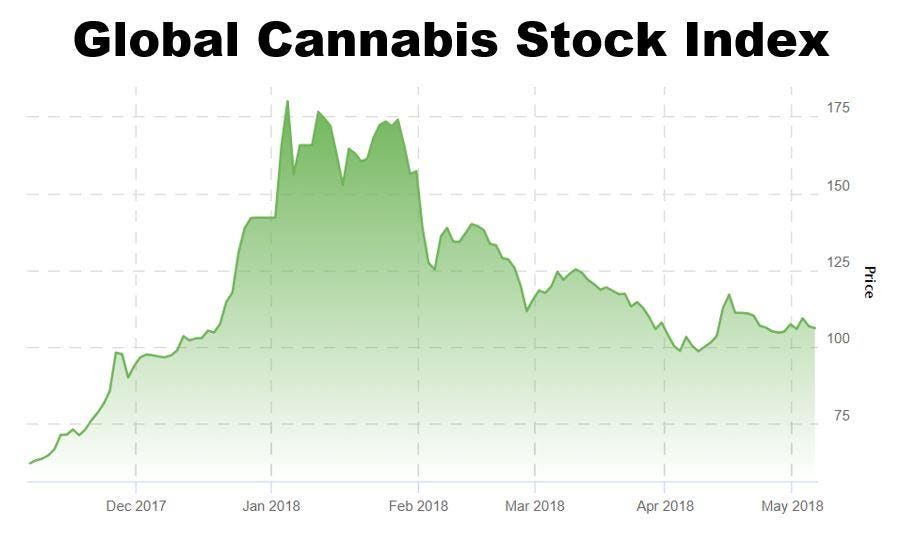
While they are down from the multi-year highs set earlier in this year, cannabis stocks remain in the rally mode. Continued progress at the state level and perhaps a friendlier federal approach to dealing with public policy issues like taxation, banking and research have left the Global Cannabis Stock Index up 71% over the past six months:
New Cannabis Ventures
Global Cannabis Stock Index
California legalizing at the beginning of the year and the media coverage it inspired brought a lot of new investors into the sector, many of them new to investing. Though the number of companies that have a shot at succeeding has improved greatly over the past couple of years, I characterize the vast majority of the 600+ cannabis stocks I track as having very little chance of success. Most of these stocks trade on the OTC, meaning that the stocks are not listed on NASDAQ or the NYSE, and many of these have limited access to capital and businesses that aren't producing much revenue, if any at all. Many of the new investors to the sector are attracted to some of the worst companies because of stock promotion and hype or simply the appealing nature of their name or trading symbol, failing to do a proper investigation of the management team, its business plan and its financial condition.
Failure to do due diligence is the most obvious mistake an investor can make, but, having followed the sector now for over five years, I think there are several others that are worth discussing, which extend beyond just the cannabis sector.
Mistake 1: Failure to Diversify
Many first-time investors in the sector or even in general invest in just one or two companies. This strategy is risky in general but especially in the cannabis sector, which consists of a lot of companies without much operating experience. The longer-term focused model portfolios I run at 420 Investor both hold more than a dozen stocks, and even this seems low to me. When I was a portfolio manager, my client portfolios typically held 18-24 different stocks.
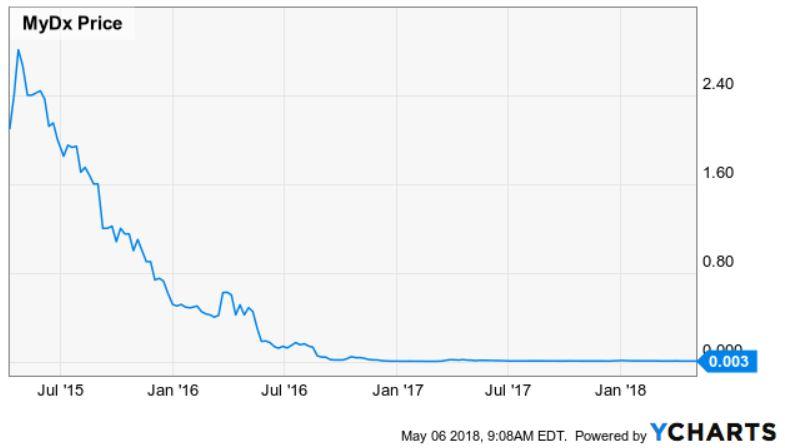
Having just one or a few positions is risky because the chance of a large loss (or large gain, to be fair) is higher than when one doesn't put all one's eggs in one basket. If one owns one stock, and it suffers a 50% loss, which is not at all uncommon in the cannabis sector, then that stock must now double to get back to even. Most cannabis stocks are not generating positive cash flow, and many of them rely on convertible notes to fund their operations. This form of financing causes long-term downward pressure on the stock, as the debt is often convertible at a discount to the market price of the stock. The holder of the debt sells the stock acquired at a discount into the market, and this creates a vicious cycle that can wipe out a company. A great example of this is MyDx, which has lost over 99% of its price as its share-count has exploded due to conversions of its debt to equity over the past three years:
In the cannabis sector, many of the first-time investors have limited funds, and they purposefully limit themselves to a small number of stocks to control the overall cost of commissions. Given the lack of mutual fund alternatives, there aren't a lot of other options. I would suggest, though, that anyone with $10,000 or more should be able to buy at least 10 stocks, as online commissions are as low as $5 per trade, and this would cost just 0.5% of the funds available.
While I advocate that investors not bet it all on a single stock, this can be a lot like telling someone that they shouldn't play the lottery. Most people will lose, of course, but someone wins more money than they can likely spend the rest of their life. I recently heard from one of my subscribers at 420 Investor about how he had invested about $40,000 four years ago into the sector without much success, but, more recently, he had turned it into almost $1 million after joining our community in late 2016. His strategy was to invest in just one or two names, the ones he felt I liked the most, and hold them for a while. I know the names he bought, and I can see how he did very well, as risky as this concentrated strategy might be.
Betting it all on a single stock or two can have a big payoff, but the risks are quite great. If one is going to limit themselves to just one or two names, one had better understand the inherently risky nature of stocks, especially penny stocks, and one should be careful to avoid companies with convertible debt that has no floor on the conversion price.
Mistake 2: Too Much Diversification
Many new investors build portfolios with a very large number of stocks. While being diversified is less risky than having no diversification, it's very possible to have too much diversification. Adding 20 companies with negative expected returns won't improve upon one's portfolio most likely,  but it will dilute it. As I indicated earlier, there just aren't that many cannabis stocks that merit investment at this time, in my view, so building a portfolio with 50 stocks would by necessity force one to include a bunch of stinkers.
I will never forget meeting one of my subscribers when I was in Atlanta in 2014, just after the market had rolled over following its meteoric rise after Colorado opened the doors to retail cannabis stores at the beginning of the year. He shared with me his portfolio, which must have had 50 holdings at a time when I struggled to find even 10 that weren't outright scams, and some of the names were obvious scams to me. Needless to say, a lot of his holdings evaporated over time.
The Biggest Mistake: Relying Solely Upon Press Releases
As I mentioned above, failure to do due diligence is the worst mistake an investor can make in my view. Many cannabis investors seem to rely upon company press releases as their primary source of information about the company, but they are omitting a better one: The company's filings which can be found at www.OTCMarkets.com (or www.sedar.comfor Canadian-listed securities).
U.S. companies can be divided into two groups: Those who file with the SEC and those who don't. Many are surprised to learn that companies don't necessarily have to file with the SEC, which is true. I caution against investing with any company that fails to do so, but many of the most actively trade stocks, like Hemp, Inc. and Medical Marjuana, Inc. have never filed with the SEC.
Press releases are typically bullish in their nature, while the company's filings are more balanced and can reveal important information about the company. Investors can learn about the financial position of the company on a quarterly and annual basis, the share structure, the compensation and ownership of insiders, litigation and other important information that may not be required to be released in a press release.
My experience suggests that investors who read the filings can gain an edge, getting information that most other investors miss. Many times, a filing with the SEC has more complete information than the press release issued at the same time, as I demonstrate below.  Reading the filings, in my view, is one of the best ways investors in the cannabis space can protect themselves from unforeseen risks.
These Companies Don't Want You to Read Their Filings
American Cannabis Company, based in Denver, is one that I have followed very closely over the past four years and that I currently include on my Focus List of 25 stocks. The company failed to file its 10-K annual report by the mid-April deadline and still hasn't done so. Thus far, it hasn't issued any sort of explanation beyond an SEC filing on April 2nd that said "The Company is unable to file its Form 10-K within the prescribed period without unreasonable expense because management has not been able to complete the adjustments necessary to close its books for the fiscal year end. The Company fully expects to be able to file within the additional time allowed by this report." On April 25th, it filed an 8-K (but no press release) indicating that it had terminated its CFO and appointed a new one, Bob Hymers, who also serves as the CFO of another penny stock, where he has been an aggressive seller of its stock. American Cannabis Company, which has historically been one of the higher quality names in the space despite disappointingly slow progress, has really dropped the ball here, failing not only to meet its responsibility to file financials on a timely basis but also to properly communicate the issue with its investors.


Hemp industry loses case against U.S. drug enforcement agency

By AP
Source: journalrecord.com

A federal appeals court sided with the Drug Enforcement Administration and upheld its decision that CBD is a Schedule 1 controlled substance – a major setback for the American hemp industry.

A panel of judges for the 9th U.S. Circuit Court of Appeals shot down the hemp industry’s challenge of a DEA rule that established a drug code for marijuana extracts.
DEA officials had said the code was intended to track cannabis derivatives used in research and to meet treaty obligations, adding that these extracts and byproducts remain Schedule I substances that the government says have no accepted medical use, such as heroin, LSD, peyote and ecstasy.


3 States Most Likely to Legalize Marijuana This Year

By Keith Speights
Source: fool.com

Going green has taken on a new meaning in the U.S. Thirty states plus the District of Columbia now allow legal use of medical marijuana. Eight of those states, along with D.C., also have legalized recreational use of marijuana. The numbers in both categories could be higher in the not-too-distant future.
Two states appear to be on course to legalize recreational marijuana in 2018. Another state could also join the ranks of those allowing legal use of medical marijuana. Here's what you need to know.
View photos
Image source: Getty Images.
 

1. Michigan

Michigan already allows patients to use medical marijuana. The prospects of the Wolverine State also legalizing recreational marijuana now look better than ever.
The Michigan Board of State Canvassers gave its stamp of approval on April 26, 2018 to an initiative to put recreational marijuana legalization on the ballot later this year. Supporters needed to gather 250,000 signatures; they ended up with more than 365,000.
There's one compelling reason why states like Michigan are considering allowing recreational marijuana: higher tax revenue. The proposed ballot measure would legalize possession and sale of up to 2.5 ounces of marijuana for recreational use, if passed. All recreational marijuana sales would be taxed at an additional 10% on top of Michigan's current 6% sales tax. The revenue generated would be used to fund education, roads, and cities and counties with marijuana-related businesses.
It's possible, however, that legalization of recreational marijuana won't be on the ballot when voting takes place in November. The state legislature could pass a bill to legalize recreational marijuana even sooner.
Republicans are currently in control of Michigan's legislature. Some of them are concerned that having recreational marijuana legalization on the ballot could boost voter turnout in ways that hurt their chances to maintain their majority.  
 

2. New Jersey

It was clear nearly a year ago that New Jersey could be headed down the path to legalize recreational marijuana. Then-candidate for governor Phil Murphy publicly voiced his support for legalization.
Fast forward to today. Murphy, a Democrat, is now governor of New Jersey, and his party controls the state's general assembly.
Gov. Murphy is promoting a bill that would legalize recreational marijuana in his state. He even included additional taxes from recreational marijuana sales in his proposed budget for New Jersey's next fiscal year, which begins on July 1. However, Murphy is running into obstacles.
Some members of his own party are opposed to legalization, as well as most Republicans in the state assembly. In addition, public polls have shown that New Jersey residents have mixed views on allowing legal use of marijuana. A recent Stockton University poll, for example, found that 49% support legalization of recreational marijuana, with 44% opposed. With a margin of error at 3.65%, the poll's results certainly don't indicate a consensus.
Still, with the top elected official in the state pushing hard for legalization, there's a decent chance that New Jersey will join the list of U.S. states that allow recreational marijuana. Peer pressure could make a difference in the outcome: Support is building to legalize recreational pot in neighboring New York state.
 

3. Oklahoma

Oklahoma currently has no laws broadly allowing legal use of marijuana for either medical or recreational purposes. The state does, however, have a law in place allowing medical use of cannabis extracts that have high levels of cannabidiol (CBD) and low levels of THC (the primary psychoactive ingredient in marijuana).
However, that could change on June 26. Oklahomans will vote that day on State Question 788, which proposes legalization of medical marijuana and the establishment of a state system to tax and regulate its use. If the measure is passed, patients would be able to legally purchase medical marijuana at licensed dispensaries with authorization by a physician. They would also be allowed to grow up to six mature marijuana plants on their own.
The proposal would impose a 7% sales tax on sales of medical marijuana and would generate additional money through licensing. Three-quarters of any excess revenue from medical marijuana would go toward funding education in Oklahoma, with the remaining one-quarter used to fund drug and alcohol rehabilitation programs.
Polls taken earlier this year indicate that the majority of Oklahomans support the proposal in State Question 788. Another ballot initiative could be on the way, too. A group called Green the Vote is gathering signatures to include State Question 797 -- which would legalize recreational use of marijuana -- on the ballot in November. 
View photos
Image source: Getty Images.
 

Investing opportunities

Despite the continued increase in public support for marijuana legalization and the growing number of states allowing either medical or recreational marijuana, there remain very few decent investing alternatives to capitalize on these trends. Most of the biggest marijuana stocks are Canadian companies that don't have major operations in the U.S. because of federal anti-marijuana laws. And most of the stocks of U.S. companies in the marijuana industry are penny stocks -- which have significant risks.
However, investors might want to take a look at two U.S. stocks that could benefit from the expansion of cannabis in the U.S., and especially if additional large states like Michigan and New Jersey legalize recreational marijuana. Scotts Miracle-Gro (NYSE: SMG) and Kush Bottles (NASDAQOTH: KSHB) aren't marijuana growers, but they could profit from growth of marijuana usage in the U.S.
Scotts Miracle-Gro sells fertilizer, hydroponics, lighting systems, and other supplies to cannabis growers. The company has placed big bets on pot, making multiple acquisitions in recent years, including the $450 million buyout of hydroponics products company Sunlight Supply only a few days ago. Most of Scotts' revenue, though, still comes from its lawn and garden products. The stock is a less risky option than most for investors wanting to buy a marijuana stock.
Kush Bottles was the top-performing marijuana stock of the first quarter. The company makes bottles and child-resistant containers for cannabis growers and assists them with branding solutions. Kush has operations in California, Colorado, and Washington state, all of which have legalized recreational pot. The company is a lot smaller than Scotts Miracle-Gro -- however, it has a much steeper valuation.
Neither stock is a perfect vehicle for investing in the marijuana industry, but there simply aren't many options from which to choose right now. Investors might be better off looking north to Canada until the day comes when the federal government officially allows states to make their own decisions about cannabis.
 

Friday, May 4, 2018

Cannabis Cultivation Will Be A Race To The Bottom

By Kris Krane
Source: forbes.com


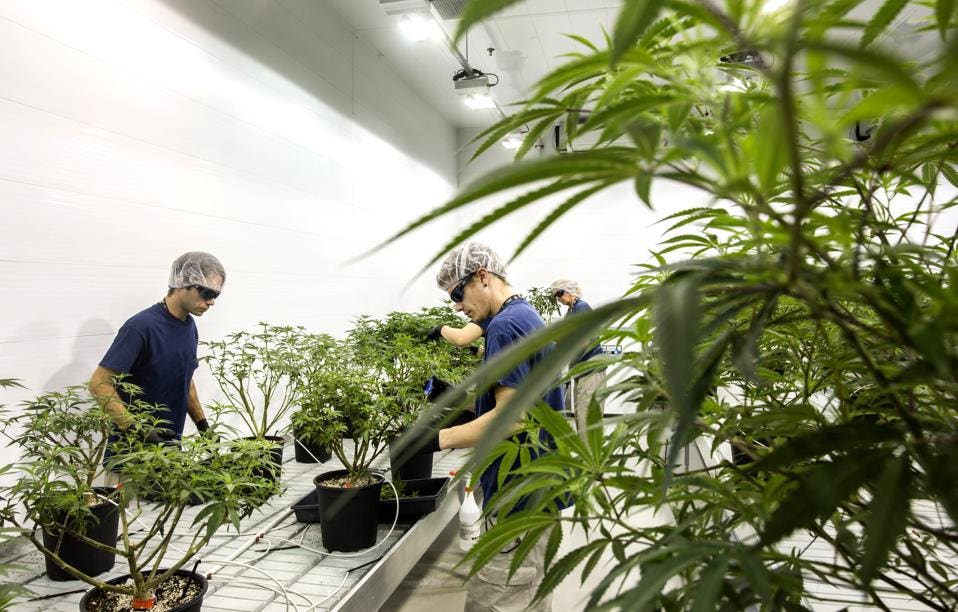
Employees work in the Mother Room at the Canopy Growth Corp. facility in Smith Falls, Ontario, Canada, on Tuesday, Dec. 19, 2017. Canadian medical marijuana is setting the stage to go global. The country's emerging legal producers have a chance to seize opportunities in other countries that could make them worldwide leaders, according to Linton. Photographer: Chris Roussakis/Bloomberg

The current “green rush” has brought with it an intense focus on large-scale cannabis cultivation. Across the United States and around the globe, we routinely hear stories of companies building larger and larger cannabis farms. In Arizona, Colorado, California, and Oregon, cannabis is being cultivated in greenhouses in excess of 250,000 sq. ft. that are capable of yielding more than 50,000 pounds of flower. While large-scale Canadian producers are building greenhouses in the millions of square feet and building similar-sized facilities in Europe, Australia, and elsewhere.
In the United States, cultivation licenses are often viewed as the most valuable in the highly competitive application processes that most states use to determine who is allowed to cultivate and dispense in their states. This value is partly derived from the fact many populous states initially only grant a limited number of cultivation licenses. For example, Pennsylvania, with nearly 13 million people, only granted 13 licenses; Florida, with a population over 20 million, granted 7; while Ohio, with more than 11 million people, granted 12; and New York, with a population of nearly 20 million people, granted only 5 before recently expanding to 10. For context, Colorado has roughly 1,400 licensed cultivators for a population of just 5.5 million people. Competition for these limited permits is fierce, and those companies fortunate enough to win one see sky-high values attached to these licenses even before they become operational. In Florida, a coveted cultivation/dispensary license sold for $40 million before the company had seen a dime in revenue. Similarly, a pre-revenue New York license sold for $26 million.
Indeed, in states with limited cultivation licenses, those companies that hold them can see large returns on their investments in the near term. With artificially limited competition due to restricted license classes, cultivators in many states are able to control pricing and sell their product in large volume. Many of these cultivators grow their product in state-of-the-art indoor warehouses with clean-room environments that resemble pharmaceutical production facilities more than traditional commercial agriculture.
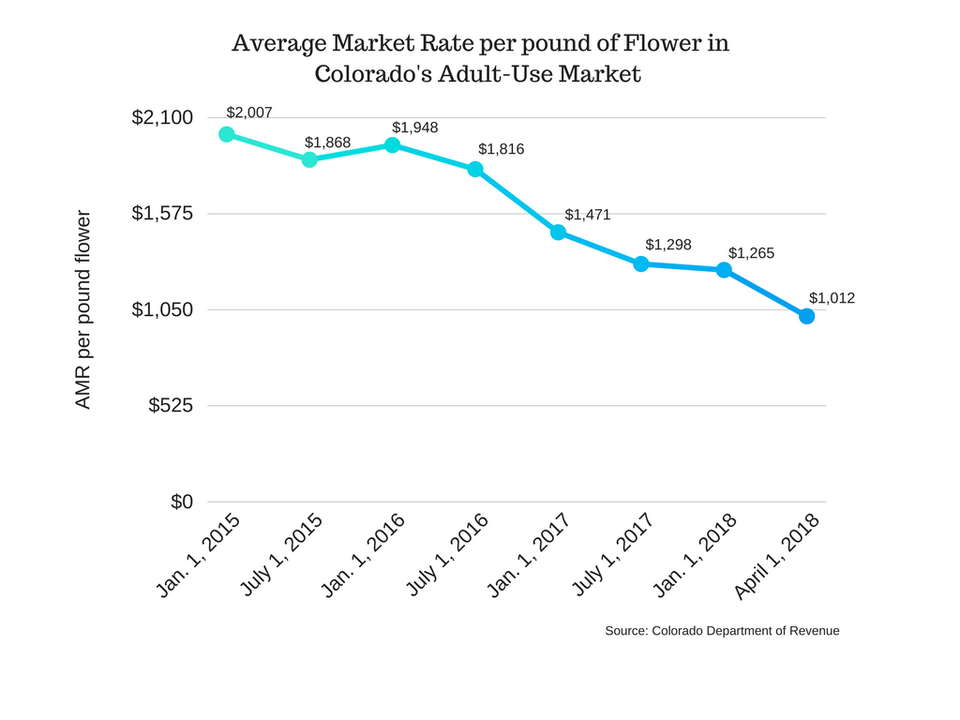
But is this trend sustainable? Or are these companies setting themselves up for long-term failure? As mentioned in my previous column “Are Canada's Cannabis Companies Overextended?”, we’re already seeing a trend towards large-scale greenhouse and outdoor production, which is driving prices down in states that do not have strict limits on the number of licenses they grant. For example, the average wholesale cost of cannabis in Colorado has dropped from nearly $3,500 per pound at the start of legalization in 2013 to roughly $1,012 a pound on April 1, according to the Colorado Department of Revenue. In Oregon, where the state ramped up licensing after early product shortages, wholesale marijuana trim (after harvest, the cannabis is trimmed of its leaves; those leftover leaves are referred to as the “trim” and can be used to produce cannabis products) is now selling for as low as $50 per pound, which is reportedly driving some cultivators in the state out of business.
4Front Holdings
This trend will only continue when the federal government’s 80-year experiment with cannabis prohibition finally comes to an end. Today the cannabis industry is defined by individual state markets, where no product can cross state lines due to laws prohibiting interstate commerce of a federally illegal product. But when prohibition eventually ends, then interstate commerce will open and businesses will be allowed to import their cannabis from any state in the country. When this happens, we can expect that large-scale outdoor and greenhouse production will dominate the market as cannabis commodifies. Many of the same environmental conditions that make northern California ideal for the production of grapes for wine will also make it ideal for large-scale commercial cannabis production. The largest greenhouse complex in the country, estimated at approximately 300 acres (approximately 13 million sq. ft.) of greenhouse space, is located in Wilcox, Ariz., because the desert conditions make it ideal to control humidity in a greenhouse setting, something that adds a huge additional cost to greenhouse operators on the East Coast. These same conditions will apply to cannabis.
With the end of prohibition will also come potential access to international imports. The company that operated the aforementioned greenhouse in Arizona, which focused on winter month cucumber and tomato production, was recently put out of business in large part due to the proliferation of large-scale commercial greenhouses in Mexico, where labor and operating costs are substantially lower. Mexico is already making moves to allow the production of medical cannabis. Meanwhile, Colombia has begun licensing cannabis cultivators for export, and has stated its intention to be the largest exporter of cannabis in the Western Hemisphere. Once federal prohibition has come to an end in the United States, producers in these countries will look to import into the largest market in the world. The same market factors that have decimated the domestic production market for greenhouse-produced vegetables and cut flowers will likely eventually be at play in the cannabis market, as well.
Investing in large-scale cannabis cultivation today is like playing the end of alcohol prohibition by buying a hop farm.What investors should be more focused on is controlling brands and the distribution points for those brands.
Simply put, in the long term it will be simply untenable for large-scale indoor cannabis producers in the United States and Canada to survive. Even greenhouse producers in most regions of the country will struggle to compete with low-cost production on the west coast and Latin America. For those companies currently spending millions of dollars building out state-of-the-art, high-tech, clean-room cultivation facilities across Pennsylvania, New York, Florida, Massachusetts, and elsewhere in the United States, be warned, you may find yourselves stuck with a beautiful state-of-the-art dinosaur.