Thursday, July 7, 2016

Hastings gets first cultivated hemp field in Minnesota since 1950

By Noura Elmanssy
Source: hastingsstargazette.com


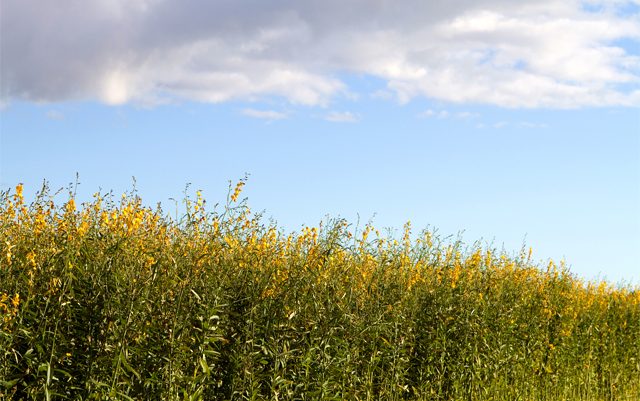
John Strohfus (pictured), owner of Strohfus Stock Farm, hopes to have hemp on the shelves soon. Strohfus, along with Ben Thurmes and Ken Anderson, is spearheading this endeavor. (Star Gazette photo by Noura Elmanssy)


John Strohfus, owner of Strohfus Stock Farm in Hastings, grows a lot of things, but recently with the help of his partners Ben Thurmes and Ken Anderson, he’s added hemp to his list and made some history doing it.

Eighteen acres of hemp was planted on June 17 in Hastings. It was the first time since 1950 that hemp has been intentionally planted in the state of Minnesota.

The trio, in partnership with the Minnesota Department of Agriculture (MDA), is participating in the Hemp Pilot Program, which aims to show how viable hemp could be in the Minnesota market.

“I thought it would be a new and exciting crop,” Strohfus said. “It was something that would be a good fit for our small acreage.”

The pilot program that was announced in March of this year allowed the growth of hemp as long as the crop could be monitored by the MDA, Strohfus explained. The program is an effort “to study the growth, cultivation, or marketing of industrial hemp,” according to the Minnesota statute on industrial hemp development.

While other farms are involved, Strohfus has the biggest planting.


Strohfus, Thurmes and Anderson all graduated from Hastings High School but didn’t get in touch until later in their farming careers. Strohfus and Thurmes had partnered in some farming ventures, and Strohfus reached out to Anderson, who knew a lot about the industry, when he had realized this can be done in Minnesota.

“(Anderson) has been an advocate in the hemp industry for many years … he has also been an advocate for and a lobbyist for the legalization of hemp as an agricultural product and was involved with the first planting in the United States in 2015 in Kentucky,” Strohfus said.

They submitted a proposal in April to the MDA and by May, they were approved and signed a contract. Strohfus said they had to wait some time before the seed arrived. When it did, a donation of grain drills from Value Implement of Ellsworth, Wisconsin, and Niebur Implement of Miesville made planting easy.


What is hemp?

Hemp, sometimes known as industrial hemp, is a variety of the cannabis plant. There are two forms of hemp, industrial and food grade. Industrial hemp can be used for fiber, straw, construction materials and more. Hemp for grain production is used for the food supply chain. Strohfus said that they are planting the grain variety. Food grade hemp seeds can be used in a variety of dishes like cereal or salads and is used to make hemp seed oil, a possible substitute for traditional cooking oils.

“They’re easy to eat and cook with, and they have a pleasantly nutty taste, like a cross between a sunflower seed and a pine nut,” Christina Chaey wrote in an article for Bon Appétit.

Cannabis is most commonly associated with marijuana, as the cannabis plant is the same species that produces the drug. Hemp and marijuana, however, are two separate products.

According the National Hemp Association’s website, “one of the biggest misconceptions is believing that industrial hemp is the same thing as marijuana. The two plants are from the same species but are more like first cousins and NOT identical twins.”


"Industrial hemp and marijuana are cousins of each other but they’re really apples and oranges as far as plants goes,” Strohfus said. “So much, in fact, that one of the concerns with law enforcement was that people may come out to a field of industrial hemp and try to hide marijuana in the middle of it because you can’t distinguish the plants between each other by just looking at the leaf structure; however, industrial hemp will actually kill off marijuana and so they can’t co-exist in the same, same area.”

Due to its association with the cannabis plant, hemp became illegal in the United States through the Controlled Substances Act of 1970. Although hemp has a very low tetrahydrocannabinol (THC) level, which is what gives marijuana its potency, was still considered a threat and was banned from then on.

As a part of the pilot program, Strohfus explained, a license had to be purchased through the MDA in order to sell and market the product freely. The money paid goes to monitoring the plant by taking tissue samples to ensure the THC level is below the required 0.3 percent.

“Our hope is that in the coming 12 months, at the federal level, that hemp will be removed from the drug enforcement agency’s schedule one narcotic list,” Strohfus said, “and will no longer be listed as a narcotic and or listed specifically different from its cousin, marijuana, and that way state licensure will no longer be needed to regulate it, it would be a free market, agriculture product like corn, beans, wheat or oats. That’s our ultimate goal.”


Where is the U.S. hemp industry now?
With the help of the United States Department of Agriculture Farm Bill of 2014, hemp was recognized as a crop and states were given the authority to grow hemp as long as they also developed a research program to study the growth and cultivation of the plant.

As of 2015, Colorado, Kentucky, Tennessee, Vermont and Oregon had all begun to grow hemp, joining 14 other states that produce hemp.

“Our (Minnesotan) soils are very conducive to growing hemp,” Strohfus said, “and you know, historical data – it’s been documented that Minnesota and Wisconsin had some very, very good hemp yields back in the 30s, 40s, 50s until it was banned and also the varieties that have been developed now in Canada – Canada soil types are similar so we’re planting a Canadian variety.”

Canada started to research the crop in 1994 and it remains a very popular location for hemp, along with other countries like Romania, the largest commercial producer of hemp in Europe.

With the addition of programs like the hemp pilot program in Minnesota, Strohfus said he hopes to make this crop once again viable in the farming industry.

“All three of us have a pretty good vision around that we want to make this a Minnesota soil-to-shelf product,” he said. “We don’t want to ship it to California for processing. We’d like to figure out a way to work with Minnesota partners and get it on store shelves in Minnesota within this first year.”


What’s next?

With the largest planting in the program now in the ground, Strohfus said that monitoring the product is the next step and making sure the logistics are developed in order to have a successful market.

“Other farmers will be able to feel confident that they can actually recover and profit from the grain as they could bean or corn,” he said.

Establishing a market for hemp will be a challenge, he said, but if successful, it stands to be well worth the effort.

“... The profit margins will be much higher than the current margins for corn or beans or other smaller grain crops, wheat and oats as well,” he said.

Overall, Strohfus said that the journey has been filled with learning and growth and hopes that this program impacts the hemp industry in Minnesota.

“It’s been really, really fun so far, we expect to learn a lot,” Strohfus said. “Hopefully we can actually get the packaging and the placement on the store shelf, that would be the ultimate bonus, but if we can at least get to a successful yield, successfully cleaned grain and be able to market that to the current buyers, that would be good enough and then getting it on the shelf would be the ultimate prize for this year.”


Build new City Hall out of hemp

Letter to the Editor
Source: registerguard.com


Redirect architects to design and build Eugene’s new City Hall using industrial hemp, hempcrete or panels. Maximize resources and ecological values proactively addressing climate disruption, energy and housing crises. Catalyze resilient economies utilizing hemp, non-mind-elevating cannabis (not marijuana).

Hemp, the future in building, can be used today for construction under alternative building procedures.


Hempcrete, made of stalk hurds and lime or magnesium oxide, is 15 percent the weight of concrete. It’s fireproof, rodent proof and termite proof. It’s water and mold resistant. And non-toxic.

Wood or steel provides framing. Hempcrete interiors are cooler in summer, warmer in winter. Buildings can last centuries and sequester carbon.

Exteriors resemble stucco, interior walls plaster. Painting is optional. Hemp provides a material universe: roof tiles, insulation, bricks, plastic and carpet.

Since 2014, industrial hemp can be grown experimentally in states such as Oregon that have legalized industrial hemp. Locals could grow and process hemp, the 1800s premier agricultural crop, for a trillion-dollar bio-regional job-producing industry.

Meanwhile, crowd-fund to help transport materials here.


KATHY GING

Eugene


Elgin farmer considers hemp growing an experiment

By Lauren Donovan
Source: bismarcktribune.com

hemp photo 1

RURAL ELGIN — Clarence Laub figures there’s no right or wrong outcome to an experiment, just a learning curve.
That’s the view he’s taking of a 10-acre hemp plot near the family farm south of Elgin that’s part of a statewide pilot program to see if the crop has potential for North Dakota growers.
Right now, it doesn’t look like much: Emerging growth is uneven and fairly spotty across the field. He planted June 1, and for most of the month the seeds received less than an inch of rain.
A good shot of precipitation recently made a substantial difference, and Laub is starting to see tender new plants coming in, along with patches where the plants are a foot tall or better. Even as he walked the field Friday, a good rain was coming in from the west, so he remained hopeful that he’ll have enough hemp seed to process after a small harvest.
“The first time you will have failures, but you have to be able to go through it and learn from it. It’s trial and error,” he said.
Laub is rethinking his planting technique. He plans to bring in a no-till drill next year and get more depth consistency in the range of three-fourths of an inch. He put this crop in with a hoe drill and thinks that might have placed the seed a little too deep for best germination.
“I’m hoping I could get a more uniform stand,” he said.
Laub is lining it up so if he has a decent harvest, he’ll order a cold press and run the seed through it to separate the oil from the meal, as each element has a marketable use. That, too, will be an experimental part of the process.
The state Agriculture Department is sponsoring the hemp pilot program, procuring seed from Canadian growers, transporting it to Bismarck and redistributing it to seven growers who seeded slightly over 70 acres combined.
Rachel Seifert-Spilde, plant protection specialist for the department, organized the program and has been in contact with participating growers in LaMoure, Grant, Foster and Benson counties, along with a small plot at the Langdon-based Research Institute.
“In LaMoure County it looks fantastic, more than 4 feet tall. In the western half, where there’s been less rain, it isn’t progressing as well,” Seifert-Spilde said. “There were varied planting days, but it all helps with the baseline data.”
She said the LaMoure growers are planning to host a field day July 20, so anyone interested can have a look.
Laub said he’s had local farmers ask him how it’s going, but he hasn’t had folks pull into the driveway to check it out, which he half expected would happen.
“I haven’t seen that, but if people want to see it, this is intended so people can learn from it,” he said.
He plans to give it another go next year. Seifert-Spilde said she’s hoping the hemp pilot can continue, but it all depends on the department’s budget, which will be under some pressure in this oil-depressed revenue situation.
“We’re intending to do it another year, but we are not certain,” she said.
Hemp is still under a federal restriction because of its relationship to the marijuana plant, and it’s illegal for anyone to grow except under the research auspices.
Laub said no one can go into his field unless they’ve cleared a background check, and he’s restricted from selling or keeping unprocessed seed. That’s not a problem, because for him it’s all about learning best practices and passing them along.
“I’m looking at the agronomy aspect, and I just want to help other farmers get into this. There’s a lot of opportunity with it,” he said.

Could Hemp Disrupt the Energy Industry?

By Daniel Matthews
Source: sustainablebrands.com


In West Virginia, residents will soon be seeing a lot more green than they’re used to. And it may come in the form of dollar bills, too.
Researchers from West Virginia University are teaming up with a new startup called Agri Carb Electric Corporation to investigate the farming infrastructure benefits of hemp. This will mark the first time West Virginia has allowed hemp cultivation in 70 years. 
The state is taking advantage of the Federal Farm Bill, which Obama signed in 2014. The bill allows states to cultivate hemp for research and pilot programs. 23 other states have already begun growing hemp in the last two years.
Hemp is a resilient plant. It’s capable of phytoremediation, a process in which the plant leaches pollutants from the soil, hyper-accumulates them, and metabolizes them. Phytoremediation works particularly well on sites contaminated with heavy metals, uranium, and arsenic. This could potentially clean up fields in West Virginia that have been contaminated by coal and gas extraction. 
“There are a lot of contaminated brownfields throughout West Virginia that people find too expensive to cleanup,” said Agri Carb’s CEO, Don Smith II. “We can be a complement to the state’s coal and gas industries by using a hemp cash crop to revitalize spoiled lands. This research should interest every post-industrial community in West Virginia to invest (with grants) and monetize what is now considered worthless.”   
The idea here is not just to clean up the fields with hemp, but to use the plants for products that will bring in cash. Hemp has a wide variety of uses, including textiles, fuel, paper, food, plastics, and construction materials.
Although Agri Carb frames this as a boon for West Virginia, the implications go beyond that. Imagine an entire economy supported by the sustainability of hemp. 
So what is Agri Carb, and why is the company interested in sustaining agricultural infrastructure with hemp? 

‘West Virginia’s newest cleantech startup’ 

Erik Janus is Agri Carb’s VP of Scientific and Regulatory Affairs. He’s also the Director of Business Operations at Compassion West Virginia, a non-profit working toward “comprehensive medical cannabis reform” in West Virginia (marijuana and hemp are two varieties of cannabis).  
According to Janus, “Agri Carb seeks to demonstrate and market advanced carbon applications from a sustainable agriculture base, and we think industrial hemp is the key to establishing a regional bio-based economy and to providing jobs and revenue in the Mountain State.”
In what may be an obvious connection, Janus and Smith were among the principle organizers of the Medical Cannabis Conference. They’re advocating for both the medical and business benefits of cannabis. No doubt they’re inspired by states such as Colorado, where legal marijuana has seen an influx of tax dollars. They point toward West Virginia’s history of opioid abuse as one reason to legalize medical pot. Opioids provide pain relief, but a study cited by WebMD found that marijuana relieves chronic pain. In that light, medical marijuana has the potential to unseat the pharmaceutical industry surrounding opioids.
Additionally, the phytocannabinoid CBD, which is found in marijuana and hemp, may be able to help treat epilepsy and schizophrenia.

Agri Carb’s buy-in

The company isn’t growing hemp for medical purposes, however. While Smith says the operation would “complement” the coal and gas industries, the fact is that hemp has potential as a fuel source. It could replace coal for electricity generation (Agri Carb is an “Electric Corporation”, after all), and it could replace gasoline: Hemp seed oil can be made into biodiesel, and you can use fermented hemp stalks to make ethanol and methanol. Biodiesel has passed EPA tests as clean-burning fuel. It’s 11 percent oxygen by weight, contains no sulfur, and extends the life of diesel engines because it acts as a lubricant. Biodiesel can run in regular diesel engines, which would save fleets money, since they wouldn’t have to replace existing trucks. 
Unfortunately, biodiesel isn’t compatible with most new diesel engines. That’s because of manufacturers’ response to standards set by the EPA and the California Air Resources Board. But hemp diesel could be used in old engines, and it wouldn’t take a lot to mandate new production of compatible engines, which could eventually replace gas engines.  
This would shift the balance of capital away from its concentration in the hands of entrenched traditional fuel interests. Coal will be supplanted first. As we’ve seen in the last year, renewable energy is on the rise while coal is losing out. If hemp becomes a renewable energy source, Agri Carb’s mission may be another nail in coal’s coffin. 
By partnering with West Virginia University, Agri Carb is taking a potentially fruitful scientific approach. If they succeed in proving hemp is a viable product for agricultural and economic sustainability, they’ll set a precedent that will be tough to ignore across the United States.    


What is the difference between hemp and kenaf?

By Kathy Garton
Source: marijuanatimes.org

difference-between-hemp-and-kenaf

Kenaf is a common source for tree-free paper. The scientific name is Hibiscus cannabinus and it is also known as jute or Deccan hemp. Hemp is a member of the Cannabis sativa species and the two plants are not related.
Ford Motor Company and BMW are implementing kenaf in the manufacturing of automobile bodies to reduce the weight of door bolsters by 25%. While being able to report that a natural-based component is being implemented, a large amount of chemical-based resin is necessary in the production.
Hemp, on the other hand, is more diverse in serving as a sustainable product. Plant based resins from soy, canola or corn are used so that a 100% biocomposite is feasible. The same lightweight structure is accomplished, but the overall structure is greener and stronger.
Kenaf, like cotton, is intolerable to cold weather.  Hemp requires the same atmospheric conditions as corn, providing a wider range of crop planting.
According to visionpaper.com:
Kenaf cannot run wild across the country like a weed, because in almost all parts of the U.S., kenaf seeds cannot mature.
Both plants have specific noted value as natural alternatives. Kenaf has softwood fibers of a high quality commonly used in commercial scale paper production. Hemp bast fiber is much longer and stronger, making it commonly used in textiles and rope making.
Both hemp and kenaf can make a significant difference in future materials. However, realizing the difference is important in how they can best be utilized.
SOURCES:

YOU CAN NOW 3D PRINT WHATEVER YOU WANT USING HEMP PLASTIC

By Chuck Ludley
Source: greenrushdaily.com

The Main Idea

A team of Italian inventors has figured out how to use hemp to create a brand new type of hemp plastic. The material is called HempBioPlastic (HBP), and it’s manufactured by the Italy-based company Kanesis.

According to the company’s Indiegogo page, the folks at Kanesis use hemp waste to create their brand new biocomposite. HBP comes as big spools of plastic filament. It can be used in 3D printers and a huge number of other industrial applications where plastic is needed.

The Details

The material was invented by Giovanni Milazzo and Antonio Caruso. They wanted to create a plastic material that could be used to create all sorts of things, but that would be sustainable and eco-friendly. So they turned to hemp fiber.

And now they say they’ve come up with a revolutionary new product. So far it’s mostly been used in 3D printing applications. In early tests HBP has scored higher than the plastics traditionally used in 3D printers.

HBP has proven to be 20% lighter and 30% stronger than Polylactic Acid, which is the most common bioplastic used in 3D printing. The plant material in HBP also bonds better than other plastics so that the final 3D printed product tends to be stronger and more durable.
“The Kanesis people work every day to promote an innovative and environmentally friendly way of thinking and behaving,” said Milazzo and Caruso. “Our aim is to contribute to an exciting new beginning for both industry and agriculture.”

Bringing Back Hemp Agriculture

But HBP is also about reviving the hemp industry. Milazzo and Caruso explained that Italy was once a global leader in industrial hemp. But after the global crackdown on all things having to do with cannabis, the country stopped its large-scale hemp agriculture. But now, Milazzo and Caruso believe that HBP could be a compelling new reason to start growing hemp again.

So far the inventors have focused on using HBP as a material for 3D printing. But they said it could be used in a variety of other applications as well.

They’re currently raising funds on Indiegogo. And the gifts they’re giving to funders demonstrate just how diverse this new material can be.

Depending on how much you donate, you can pick anything from jewelry to smoking accessories like grinders, stash jars, and ashtrays, to buttons and fashion accessories. If Milazzo and Caruso are correct, HBP could open up new possibilities for both hemp and 3D printing. Now you can use a 3D printer to make pretty much anything you want, and the entire thing will be made out of hemp.


FINLAND LEADS GLOBAL INDUSTRIAL HEMP RESEARCH

By Alice Klee
Source: greenrushdaily.com

Turku University has been awarded a grant to investigate the innovative industrial uses of hemp and hemp research. The 70,000 euro grant will take a look at ways to make industrial grade hemp more efficient and usable. It is not enormous but looks at some important aspects of hemp research to make it more usable overall.
Hemp is one of the most versatile substances on the planet. Hemp, as you may know, is essentially cannabis with one important difference: a significantly lower amount of THC.

Hemp Uses

Hemp can be used to make a whole bunch of things. For centuries, hemp has been used to make things like oils and textilesYou’ve seen some things made of hemp, like necklaces and lip balm. You can make food out of hemp, like hemp milk and granola bars.
In recent times, humans have engineered entire airplanes, furniture, and homes out of hemp. It can be made into some different consistencies and is great for the environment.
There has already been a significant amount of research done focused on hemp, as well as a push to create industrial-grade hemp products.
Buildings constructed out of steel, iron, wood and concrete takes a toll on the environment and is not terribly cost-effective.

Hempcrete

Materials such as Hempcrete and Canosmose are innovative industrial strength hemp based materials already on the market that can be used to build entire cities out of hemp. 

While these hemp-based materials are efficient and eco-friendly,  it has been difficult to find ways to make things using hemp on a large scale.

It is not a material that everyone can readily use – it can be expensive and inconvenient. This is where the grant comes in.

It will aid in finding ways to make this material more accessible for architectural construction.

The research will be done on the fireproof and soundproofing properties of hemp as a building material.

Additionally, this study will take a look at how hemp decomposes to see how it would function as a fertilizer. 

Structures made of hemp can last a long time, but when they do fall or become unusable – they can help the environment.

Researchers in Finland are trying to find out ways to make this active, eco-friendly substance into something that can be mass-produced easily.

There are amazing architectural projects out there that use hemp as a material. Knapp’s Castle, a castle built near Santa Barbara, California in 1920 was destroyed in a fire in 1940.

The structure is to be rebuilt using hempcrete and lime, making it a very secure, reliable and grand structure for years to come.

With some work, hemp could be the future. Hemp can be used to build necessary complex structures like roads, freeways, and bridges.

You can even make bio-diesel out of hemp, to fuel cars and trucks made of hemp. Being extremely eco-friendly, building with hemp offers all sorts of new opportunities as a fundamental thing. So maybe soon, most of our world can be made out of hemp.