Sunday, March 6, 2016

Tradition tweaked

Source: nyoooz.com

Tradition tweaked

 Summary: Master artisan Gajam Govardhan brings his matchless ikkat saris in a vibrant interplay of colours and motifs with some outstanding pieces. Each sari bears the artistic works ranging from iconic Ashavalis, Benarasis and fine ikats to hemp and jute-textured ‘Village Art’ ones. Radhika Lalbhai’s Ashavalis ‘speak in the language of a weave older than that of Benaras’ says designer Lalbhai. The textile show has a wealth of kurtis, tops and made-ups, high on distinctive block prints, embroidery and patchwork. Equally iconic are Abha Dalmia’s Benarasis in jewel tones and spring colours with fine motifs woven with the ‘revived’ 100-year-old ‘katan’ weave.
The textile show organised by the Crafts Council of India is a celebration of the sari and of Indian textiles in their wonderful diversity of weaves, textures and colours. The best of designer creativity is on display with saris, yardage and made-ups synergising strands of forgotten motifs and weaves and of innovation, interplay of colours and concepts, classicism and contemporary appeal. Each sari bears the artistic works ranging from iconic Ashavalis, Benarasis and fine ikats to hemp and jute-textured ‘Village Art’ ones. 

Chanderis and Kotahs, both minimalistic and touched with zari, Uppadas and Mangalagiris, Bhagalpuri and linen as well as a range of ‘high on style’ made-ups make up the collection, in which each sari tells a unique story. Radhika Lalbhai’s Ashavalis ‘speak in the language of a weave older than that of Benaras’ says designer Lalbhai. Apart from pristine Ashavalis in the traditional style, she has experimented for the first time with cotton Ashavalis in soft colours with revived ‘saudagiri’ motifs. Another first is her cotton Bandhej line of saris with ajrakh borders and ‘pallus’. These are bright with exquisite tie-and-dye work. Equally iconic are Abha Dalmia’s Benarasis in jewel tones and spring colours with fine motifs woven with the ‘revived’ 100-year-old ‘katan’ weave. 
Source: http://www.thehindu.com/features/friday-review/tradition-tweaked/article8309291.ece

Zumbrota Farmer Hopes to Grow Hemp this Year

By Megan Stewart
Source: kaaltv.com


(ABC 6 News) -- Farmers may soon be able to grow a controlled substance as part of pilot project with the Minnesota Department of Agriculture.
The move stems from the Minnesota Industrial Hemp Development Act, which was passed in last year's legislative session.
Earlier this month, the U.S. Drug Enforcement Administration granted Minnesota a permit to begin work on an industrial hemp pilot project to study the crop. State agriculture officials say soon they will be taking applications for Minnesota farmers to participate.
Farmers would need to purchase hemp seeds from Canada or another country, because they are not legally sold in the U.S.
Participants would also need to submit security and research plans to the state as part of the pilot project vetting process.
Both officials and Zumbrota farmer Andrew Johnmeyer hope to start planting the crop as soon as this spring, the first time legally in more than 50 years.
"Industrial hemp is a crop that contains only trace amounts of THC, or psychoactive substances, so people can come in and steal it, but it wouldn't get them much," Johnmeyer said.
He wants to grow industrial hemp for livestock feed and, with commodity prices so low, he will only be planting beans and barley this year.
But the clock is ticking, because soon, Johnmeyer will have to buy seed for the crops he plans to grow this year, which would put his hemp dreams on hold.
"You've already paid for it,” Johnmeyer said. “So, you might as well plant it."(ABC 6 News) -- Farmers may soon be able to grow a controlled substance as part of pilot project with the Minnesota Department of Agriculture.
The move stems from the Minnesota Industrial Hemp Development Act, which was passed in last year's legislative session.
Earlier this month, the U.S. Drug Enforcement Administration granted Minnesota a permit to begin work on an industrial hemp pilot project to study the crop. State agriculture officials say soon they will be taking applications for Minnesota farmers to participate.
Farmers would need to purchase hemp seeds from Canada or another country, because they are not legally sold in the U.S.
Participants would also need to submit security and research plans to the state as part of the pilot project vetting process.
Both officials and Zumbrota farmer Andrew Johnmeyer hope to start planting the crop as soon as this spring, the first time legally in more than 50 years.
"Industrial hemp is a crop that contains only trace amounts of THC, or psychoactive substances, so people can come in and steal it, but it wouldn't get them much," Johnmeyer said.
He wants to grow industrial hemp for livestock feed and, with commodity prices so low, he will only be planting beans and barley this year.
But the clock is ticking, because soon, Johnmeyer will have to buy seed for the crops he plans to grow this year, which would put his hemp dreams on hold.
"You've already paid for it,” Johnmeyer said. “So, you might as well plant it."

Harnessing Hemp as a Sustainable Resource

Press Release
Source: digitaljournal.com

NoCo Hemp Expo presented by CBDRx features eco- friendly fibers, technology, and innovation at the 2016 expo and trade show.

This press release was orginally distributed by ReleaseWire

Loveland, CO -- (ReleaseWire) -- 03/02/2016 -- Today marks 30 days until show time for the largest hemp expo and trade show in North America! Join Colorado Hemp Company at the Ranch Events Complex on April 1-2 in Loveland, CO for a one-of-a-kind opportunity and view into the hemp industry that you won't find anywhere else.

Doors open Friday at 10 AM for NoCo Hemp Expo B2B Industry Day where you can meet hemp business leaders and take away key information to grow your hemp business. Purchase a Hemp Summit VIP ticket and get access to the first-ever national gathering of hemp-focused investors, founders and CEO's. This special insider's view receives VIP access to the Hemp Summit as well as an exclusive invite to the Game Changers VIP Party. Be sure to stay for the networking event in the CoHempCo Lounge from 5-6 pm hosted by the National Hemp Association.

On Saturday, Expo attendees can get the latest on eco-friendly products and consumer trends and learn about key topics in the industry like legislation, seed certification, nutrition and wellness and much more.. Early bird tickets are $15 through March 21st online and include several "hands-on-hemp" workshops, art shows and a stylish and sustainable Hemp Fashion show brought to you by EnviroTextiles.

NoCo Hemp Expo is bringing together hemp companies and entrepreneurs from all around the globe, including Spain, Canada, China, Holland, Mexico, Ukraine and more. With over 100 vendors and exhibitors participating daily and an impressive list of experts and speakers, NoCo3 is the place to be for those who are interested in learning more about the thriving hemp market. Witness the latest innovations in industrial hemp and hemp fiber from its use in eco-friendly fashion to energy storage used to create sustainable, long-lasting super-capacitors.

According to a recent article, "One of the battery's most impressive features is its ability to discharge energy very quickly, which could drastically cut down charging times. You could recharge the device you're reading this article on in seconds."

"Hemp is a better choice, because graphene is far more expensive to synthesize, and hemp is a sturdy, renewable resource that can flourish in a range of climates."1

Author and Keynote Speaker at NoCo3 Doug Fine describes a hemp super-capacitor as "the kind of technology that's going to allow a solar-powered ranch like mine to charge a week's worth of energy from an hour of sunlight."2

Get your hands on hemp and its infinite possibilities at the third annual NoCo Hemp Expo! Skip the lines and save by purchasing your tickets here in advance. Growth Tickets are available for those who want to support the GROWTH of the hemp industry which includes a VIP hemp tote bag loaded with the coolest hemp products from our sponsors and vendors.

NoCo3 offers direct insight into the advocates, companies, and entrepreneurs fueling the change in the market today. Check out the full list of vendors at NoCo Hemp Expo 2016 and stand with hemp to harness a brighter future for a more sustainable America.

About NoCo Hemp ExpoColorado Hemp Company and TreeFreeHemp
WAFBA LLC (We Are For Better Alternatives) is home to the NoCo Hemp Expo, TreeFreeHemp and Colorado Hemp Company located in Loveland, Colorado and operating since 2012. Areas of focus include product and brand development, marketing, printing, production, events and advocacy.

1 Ebeling, Paul. "Energy Breakthrough, A Supercapacitor Battery Made From Hemp | Live Trading News." Live Trading News. HeffX, 22 Aug. 2014. Web. 02 Mar. 2016.

2 Fine, Doug. "Hemp Is on Its Way to Your Car Battery and Many Things You Haven't Yet Imagined." The Huffington Post. TheHuffingtonPost.com, 22` Oct. 14. Web. 02 Mar. 2016.


Saturday, March 5, 2016

With feds' blessing, Minnesota to try growing hemp

By Dan Gunderson
Source: mprnews.org


Hemp seeds.


Josh Helberg is ready to plant hemp — but not for the reasons you think.
A construction company owner who also owns farmland in west-central Minnesota, Helberg's interest in the crop is purely industrial.

"I'm committed to grow on our farmland and with all the benefits and uses, it's going to be incredible," he said. "I'm also a general contractor and I'm excited about all the different building products that can come from industrial hemp."
Helberg will get his chance this spring.

The state just received a permit from the U.S. Drug Enforcement Administration for an industrial hemp pilot project. Agriculture officials here say they'll soon begin looking for farmers and others who want to plant hemp test plots, the first legally planted hemp in the state in more than half a century.

The Minnesota Legislature last year ordered the state agriculture department to set up an industrial hemp pilot project. It's been a challenge because the federal government lists hemp as a controlled substance, an illegal drug.

The DEA permit was a "big step in the process," said Geir Friisoe, director of the Minnesota Department of Agriculture's plant protection division.

Friisoe said he's working on a request for proposals so people can contract with the state to grow hemp test plots, although they'll still need a permit to import hemp seeds from Canada.

"My hope is that we will have a few acres planted in Minnesota in 2016," Friisoe said. "I think just given some of the challenges we've had I think that's a good start to getting this off the ground."

• FAQ: Minnesota Department of Agriculture on growing hemp legally

There are people waiting to grow hemp in Minnesota, but expectations remain low. Time is short to get seeds for this spring. Anyone contracting with the state to grow hemp this year will need to provide land, security and a research plan.
Growers will also have to pay for the seeds.

"This is just going to be a yield analysis year for us in the state of Minnesota," said Ken Anderson, who runs a Wisconsin company that develops hemp building products and another that supplies hemp seeds. "We just need to see how the cultivars we work with perform in this growing area."

Commercial hemp production is still illegal in the U.S. But nearly 30 states have passed some kind of industrial hemp law. According the the National Conference of State Legislatures, the count is 27, not including Minnesota.


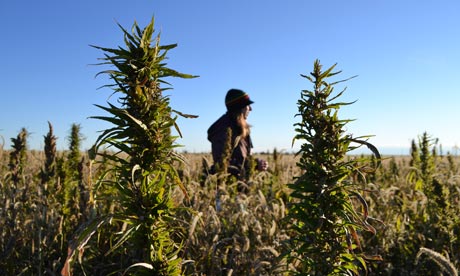
Minnesota has received a permit from the U.S. Drug Enforcement Administration for an industrial hemp pilot project. State officials say they'll be looking for farmers who want to plant test plots. Here, a volunteer walks through an industrial hemp field in Springfield, Colo. 

North of the border, Canadian farmers have been growing hemp since it was legalized in 1998. Last year farmers grew more than 80,000 acres of hemp, and Canadian companies exported millions of dollars in hemp products.

Manitoba Harvest Hemp Foods, Canada's largest hemp food company, processes about two-thirds of the hemp grown in Canada. Last year 125 farmers grew 55,000 acres for the company.

"We're seeing more and more farmers, in fact this year we had more in farmers than we had contracted acres, said Kelly Saunderson, the company's public affairs manager.

Manitoba Harvest sells millions of dollars' worth of hemp food products every year in Canada and the U.S. Top sellers are seed and oil, which contain high levels of healthy fats. But the market is still very small, Saunderson said.

"We actually recently did some consumer research that showed even with all the growth in the industry, here in Canada only 3 percent of consumers have tried hemp food and in the States it was only 1 percent," she said.

Saunderson says Canadian hemp producers support legalization of the crop in the U.S. to help expand the North American market.

Law enforcement officials have raised concerns hemp fields could hide marijuana plants. Saunderson contends that hasn't been a problem in Canada since the cousin plants look very different and cross pollinating with hemp destroys the potency of marijuana.

The hemp industry is also closely regulated.

For example, the limit in hemp plants for THC, the chemical that causes the marijuana high, is 0.3 percent of the weight of leaves and flowers. By comparison, marijuana plants often have a THC level of 5 percent or higher.

Anderson, the Wisconsin hemp business owner, believes the federal ban on hemp production will go away within a few years. That's why he's spending time and money to be on the ground floor of the hemp industry.

"If you would have asked me that same question five years ago we wouldn't be doing what we're doing. But now that a few states have come on board it's just one after another, boom, boom, boom."

Anderson is testing products like hemp reinforced concrete.

Helberg, who hopes to plant hemp on his acres in Stevens County, also sees its potential in reinforcing concrete and insulation and in products such as erosion control mats for landscaping. The market for those products is still developing.
Friisoe doesn't think hemp will ever be huge, but he's interested in seeing how much interest there is this spring.

Until federal officials remove hemp's designation as an illegal substance, it will be difficult for the plant to get a firm foothold, he said.

Still, he said he believes it could be a good alternative crop for Minnesota farmers. "I think the potential is there."


County planners, farmers see opportunity for hemp

By Jim Mimiaga
Source: cortezjournal.com

A legal hemp test plot is thriving at this undisclosed location in Southwest Colorado. Abdel Berrada, senior researcher for the Colorado State University experiment station in Yellow Jacket, and his team planted 12 varieties to determine which would best grow in the local climate.

Montezuma County planners entertained a vision of rolling waves of hemp fields as a way to bolster the local economy.
Hemp being grown by Colorado State University in southwest Colorado is hidden by a crop of corn at a secret location. Farmers interested in hemp can arrange for a tour.Enlargephoto
Jim Mimiaga/The Journal
Hemp being grown by Colorado State University in southwest Colorado is hidden by a crop of corn at a secret location. Farmers interested in hemp can arrange for a tour.
A roundtable discussion on the potential of a local hemp market struck an optimistic tone during a special planning and zoning meeting on Thursday.
“The opportunities are there for a commodity crop, and our arid climate and soils of this region are pretty ideal,” hemp advocate Sharon Stewart said during a presentation. “I’m selling my coffee shop to become a hemp farmer in Mancos.”
The industry won’t develop overnight, she warned, but Colorado is well positioned to corner the U.S. industrial hemp market since it is one of a few states that have legalized it.
Hemp is a form of cannabis but does not have the psychoactive ingredients (THC) of its genetic cousin, marijuana.
The hemp flowers, seeds, oils, leaves and fibrous stems are used for a variety of products — soaps, lotions, clothing, paper, fuel, food, medicine, an alternative to plastics and the building material hempcrete.
“Right now, the medicinal market is very strong for hemp,” Stewart said. “It comes from oil processed from seeds” and is known as CBD, or cannabidiol.
Hemp is regulated by the state, and Colorado farmers may apply for a permit to grow hemp from the state Department of Agriculture. Random testing is done to ensure it’s the hemp variety.
So far, 330 farmers, including several in Montezuma County, have obtained permits. About 3,700 acres have been planted and harvested statewide.
“Right now, it is a lot of experimentation; it grows fast, and could be good for dry land,” said Merle Root, a Pleasant View hemp farmer. “My research shows it is a good rotation crop and adds nitrogen to the soil.”
Hemp does not require herbicides because it chokes out weeds, and contends with no major pests, the presenters said.
Industrial hemp can grow 14 feet high. Side roll irrigation works early on, and center-pivot irrigation later on. Water demands are estimated at 10-12 inches per acre. It is possible to retrofit combines for hemp harvest or use a silage cutter.
The goal is to develop a local hemp cooperative and build a local processing plant.
“With enough growers, the demand for a processing plant will develop on its own and become an economic opportunity for an entrepreneur,” said planning commissioner Mike Gaddy.
Right now, a licensed hemp processing plant is operating in Fort Lupton, a potential option for local growers.
Access to seeds is getting better, Stewart said. Certified seed providers are sprouting up in Colorado, such as Centennial Seeds.
It was noted that it takes at least three seasons for a seed variety to acclimate to the local climate, though the science of local cultivars is imperfect.
CSU’s agricultural research station at Yellow Jacket is permitted to grow hemp under a provision of the U.S. Farm Bill. They plan to conduct a second year of experimental grows this spring.
A single hemp crop can produce several products – medicine from flowers and leaves, oil and food from seeds, and industrial products from its stem.
“Processing the stem is a complicated process,” Stewart said. “Educational seminars and outreach are needed, and that is part of our plan.”
Cross pollination of hemp and marijuana is a potential problem, but is less of a local issue because Montezuma County has banned commercial marijuana farms. Federal laws ban hemp production, and they typically trump state laws. Farm loans with a federal nexus could present problems, as could federal farm assistance programs, or even water sources funded by the federal sources such as the Bureau of Reclamation.
Congressional bills have tried to legalize hemp by taking it off the Controlled Substances Act, and one may finally get passed this year, Stewart said.
“You could be the pioneers of a new hemp market here,” said planning commissioner Mike Rosso.
“It would be foolish not to give it a try,” said commissioner Bob Clayton.

The Effects of CBD on Fear, Anxiety, and a Healthy Stress Response

Source: leafly.com

Phytocannabinoids like cannabidiol (CBD) are a subclass of cannabinoids derived from plants, typically hemp. In the 1800s, hemp plants were widely cultivated as a fiber source and food in the form of seed oil. Even George Washington grew hemp on his farm in Mount Vernon. Today, worldwide uses of hemp encompass hundreds of consumer products, including ropes, fabrics, paper, plastics and construction materials, and even serve as a source of protein. These same hemp plants are also the major source of commercial CBD extracts, which today are being used to attenuate fear and anxiety and promote a healthy stress response.
The Endocannabinoid System and CBD's Role in Stress, Anxiety and Fear Responses

How Cannabinoid Receptors Control Stress Response

Cannabinoid receptors (CB1, CB2, TRPV1, GP55 and others) and the biochemical machinery necessary to synthesize and generate cannabinoids are present within areas of the brain known to control emotional behavior, mood, sleep, stress, irritability, fear and even the sensation of “craving.” These structures include the prefrontal cortex, amygdala, hippocampus, nucleus accumbens, and periaqueductal gray (PAG) of the midbrain. Several lines of evidence in mice and other animals have clearly demonstrated that activation of cannabinoid receptors within the brain lowers heart rate and blood pressure responses to stress and reduces panic and anxiety behavior. Put simply, hemp-derived CBD administration appears to attenuate the well-known “fight or flight” phenomenon to physical and mental stress. Other studies using similar models in animals have shown that CBD administration decreases fear-avoidant and conditioned responses to pain or punishment.
Is Your Endocannabinoid System in Balance?
In humans, one of the earliest studies to document the beneficial effects of CBD on anxiety was published in 1982 (1). Using a double-blind, cross-over design where each subject served as their own control, eight healthy volunteers were given either 0.5 mg/kg tetrahydrocannabinol (THC), 1 mg/kg CBD, a mixture containing 0.5 mg/kg THC and 1 mg/kg CBD, or diazepam (Valium) as a control. The results showed that CBD blocked the anxiety promoted by THC, indicating antagonism between the two cannabinoids.
In another study using a simulated public speaking test to induce stress, a 300-milligram dose of CBD reduced symptoms of self-rated anxiety (2). Follow-up studies have confirmed and extended these results by reporting significant decreases in cognitive impairment and speech performance in subjects submitted to anxiety induced by several different procedures.
5 Promising Studies That Explore How Cannabinoids Interact with the Human Body

Mapping CBD’s Neurological Effects

Other more elegant studies have used single photon emission computed tomography (SPECT) and functional magnetic resonance imaging (fMRI) to examine changes in regional blood flow and neural correlates of brain activity in response to CBD administration (3,4). Results from these studies, using doses of between 400 and 600 milligrams of CBD, indicate increases in brain activity in the left parahippocampal gyrus and decreases in the left amygdala-hippocampus complex, along with attenuated responses during the recognition of fearful facial expressions in the amygdala and the anterior cingulate. Collectively, these patterns of SPECT and fMRI results are consistent with effects on alleviating anxiety, irritability, fear and stress responses from hemp-derived CBD administration.
Interestingly, a case report was published by Shannon S et al. in the journal Integrative Medicine, on hemp-derived CBD oil for decreasing the habitual use of marijuana (5). This case describes the gradual decrease in anxiety (as measured by HAM-A: Hamilton Anxiety Rating Scale) and feelings of stress and irritability from the marijuana non-use, while maintaining normal sleep quality. According to the authors, the use of hemp-derived CBD oil helped in transitioning this patient away from habitual marijuana use while avoiding negative stress responses. The neuronal circuits within the brain that control many of these behaviors and emotions appear to be positively modulated by CBD.
Given the ongoing, emerging human clinical data supporting the use of a hemp-derived CBD-rich extracts for modulating fear, anxiety and a healthy stress response, it looks like good old George Washington was a bona fide hemp pioneer.
References:
  1. Zuardi AW, Shirakawa I, Finkelfarb E, Karniol IG. Action of cannabidiol on the anxiety and other effects produced by delta 9-THC in normal subjects. Psychopharmacology (Berl) 1982;76:245–250.
  2. Zuardi AW, Cosme RA, Graeff FG, Guimarães FS. Effects of ipsapirone and cannabidiol on human experimental anxiety. J Psychopharmacol. 1993;7:82–88.
  3. Crippa JA, Zuardi AW, Garrido GE, Wichert-Ana L, Guarnieri R, Ferrari L, et al. Effects of cannabidiol (CBD) on regional cerebral blood flow. Neuropsychopharmacology. 2004;29:417–426.
  4. Fusar-Poli P, Allen P, Bhattacharyya S, Crippa JA, Mechelli A, Borgwardt S, et al. Modulation of effective connectivity during emotional processing by Delta 9-tetrahydrocannabinol and cannabidiol. Int J Neuropsychopharmacol. 2009a;13:421–432.
  5. Shannon S and Opila-Lehman J. Cannabidiol Oil for Decreasing Addictive Use of Marijuanna: A Case Report. Integrative Medicine. 2015;14:6:31-35.

Exton entrepreneur plants a future in hemp

By Brian McCullough
Source: dailylocal.com

Andrew Follett, owner of Follett Health Solutions LLC with “Cannagenix” brand hemp seeds and Liberty Bar and Grill owner Steve Schwenk, who offers a pizza with the seeds on it.
Andrew Follett, owner of Follett Health Solutions LLC with “Cannagenix” brand hemp seeds and Liberty Bar and Grill owner Steve Schwenk, who offers a pizza with the seeds on it. PETE BANNAN — DIGITAL FIRST MEDIA


Andrew Follett is like many entrepreneurs in the area: young, energetic, with a burning desire to talk about his newest venture.
But unlike those who have created the latest app or video game, Follett has a public relations hurdle to clear before his startup can become a success.
That’s because Follett Health Solutions LLC sells the “highest quality hemp foods and ingredients, to retail, food service, bulk customer, as well as end consumer product manufactures.”
But before readers get the idea that Follett is pushing to legalize the use of marijuana in food products, he hopes they take time to educate themselves on a product that is as old as the nation.
“It is part of the American dream,” the 30-year-old Exton resident and father of one said last week during an interview at the Liberty Union Bar and Grill in Chester Springs, which uses one of Follett’s products on one of its most popular pizzas. “We never would have gotten our independence without it. We never would have had our liberty and freedom.”
According to supporters, George Washington grew hemp, as did Thomas Jefferson and John Adams on their lands.
While hemp and marijuana are two popular names for the cannabis plant, hemp contains very little of the THC compound that gives marijuana its psychoactive qualities.
And its versatility makes it one of the most valued, under-utilized plants available, said Follett, who is originally from Downingtown.
It can be used in flooring products, composite materials, plastics, paper, Hempcrete building materials, food products for human consumption, livestock and poultry feed, horse bedding, biofuels, land remediation, cover crops, and more.
Follett said there’s a company in Florida that has built an entire car with hemp while Nissan and Mercedes use it in door panels, he said.
Others are using it instead of fish oil products, which many people ingest to lower bad cholesterol levels.
“We literally can save our oceans,” Follett said. “There’s not an industry right now that can’t use hemp.”


Follett has chosen food products as his initial entree into the business.
His “Cannagenix” brand hemp foods include Hemp Protein Powder, Hemp Hearts, Toasted Hemp Seed and Gluten Free Hemp Flour.
Current customers span the spectrum, from organic ranchers in the Midwest, to restaurateurs on the East Coast, he said.
Locally, in addition to the Liberty Union Bar and Grill, Follett’s hemp-based products are found at the Nourish Juice Bar and Cafe in Kennett Square, the Station Taproom in Downingtown, the Lionville Natural Pharmacy and the Nourish Juice Bar and Cafe in Kennett Square. It’s also available on keystonecannaproducts.com and Amazon.com.
Liberty Union Bar and Grill owner Steve Schwenk said his restaurant features an all-American menu that includes dishes from each state. When an item from one of the states featured is particularly popular, it stays on the menu. Such was the case with the Colorado pizza, which features elk sausage and hemp seeds.
“It caught on, it has a nice crunch to it,” Schwenk said. “It’s one of the more popular items on the menu.”
While optimistic about the success of his current line, Follett has bigger hemp dreams.
One of Follett’s goals is to get Pennsylvania to join the other states that now allow farmers to grow hemp – the practice had been banned for about 80 years.
There are two bills awaiting votes in the Pennsylvania General Assembly: Senate Bill 50 and House Bill 967. Both bills attempt to align Pennsylvania law with current federal law, supporters say. The federal farm bill passed in 2014 allows farmers to grow hemp if they are affiliated with a university research program or are licensed by their state departments of agriculture — provided those states have passed pro-hemp legislation.
Follett has been licensed by the Pennsylvania Departments of Health and Agriculture. He notes that interstate commerce involving hemp is still illegal, meaning he must import the hemp used in his products from Canada or Europe.

“My end goal in this journey is to have large acreage of a variety of hemp strains tailored to specific industry, and a processing plant capable of a broad spectrum of product-specific processing,” he said “I started my brand with many goals in mind ... I not only want to create the markets here in Pennsylvania for hemp products, I also want to create a national brand to give new ‘hempsters’ a starting point and product line to get hemp into their own local markets.”